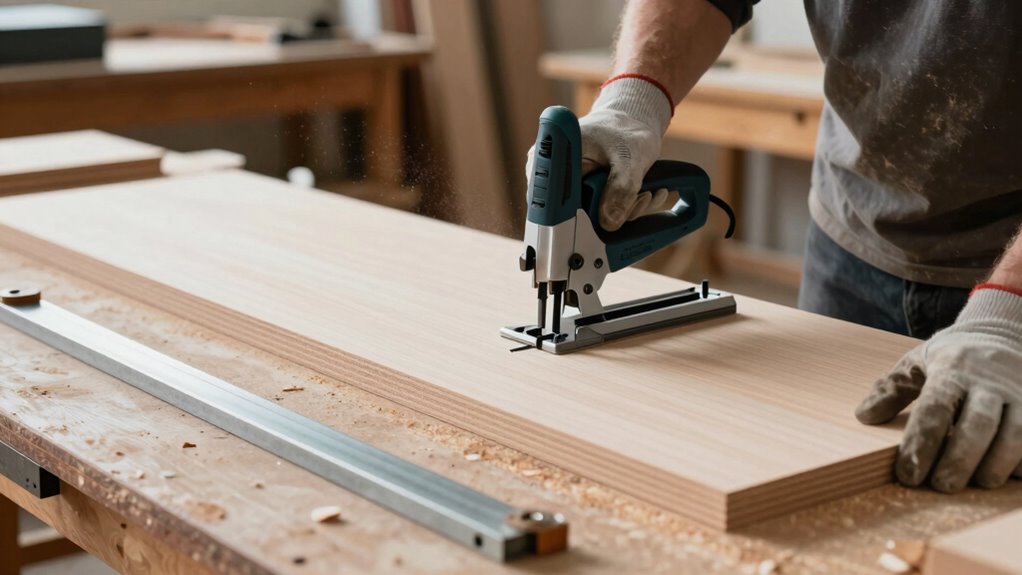
To break down sheet goods without a panel saw, use a track saw for precise, straight cuts. Measure and mark your cut lines carefully with a square or straightedge, then align the track for accuracy. Support your sheets on stable surfaces and cut slowly in smooth, shallow passes. Keep safety in mind—wear protection and ensure a clutter-free workspace. If you want to master this efficient workflow, there’s more to learn to guarantee perfect results every time.
Key Takeaways
- Use a track saw with a straightedge for precise, clean cuts as an alternative to a panel saw.
- Mark cut lines carefully with a square and ensure track alignment before cutting.
- Support large sheets evenly on stable surfaces or sawhorses to prevent shifting and bending.
- Make multiple shallow passes for thick materials, maintaining steady, controlled movements.
- Follow safety protocols by wearing protective gear and keeping the workspace clutter-free.
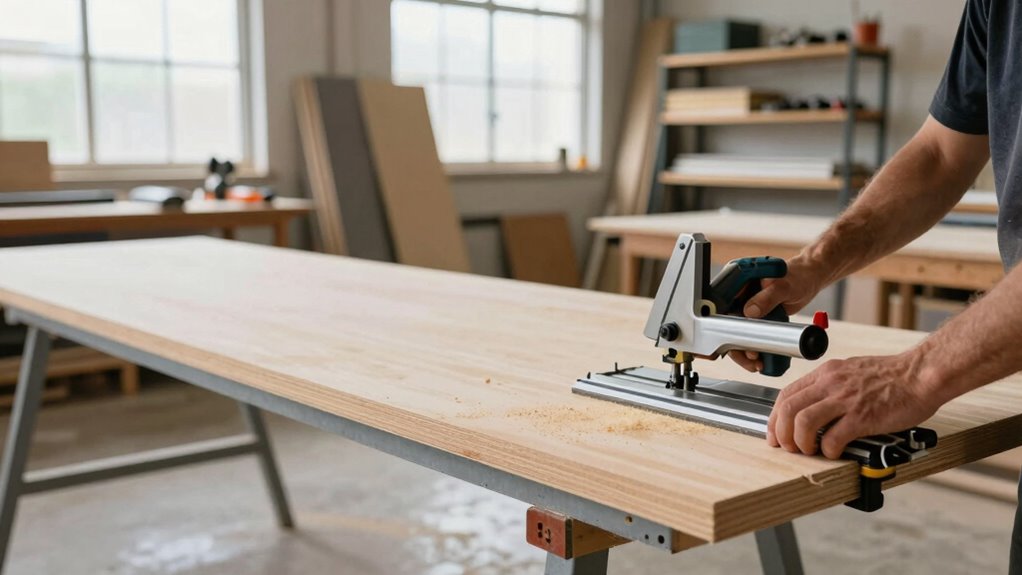
Breaking down sheet goods without a panel saw might seem challenging, but it’s entirely doable with the right tools and techniques. A track saw is an excellent alternative, offering precision and control that make breaking down large sheets manageable. To start, you’ll want to carefully measure and mark your cut lines using a straightedge or square. Precise measurements are essential to minimize waste and guarantee your pieces fit perfectly. Once your markings are in place, set up your track saw on a stable work surface or on sawhorses, ensuring the track is aligned accurately with your cut lines. Proper setup is critical for clean cuts and safety. Ensuring your cutting technique is steady and controlled helps achieve smooth edges and reduces material waste. When it comes to cutting techniques, steady, controlled movements are key. Keep the saw moving smoothly and steadily along the track, applying even pressure to avoid jagged edges or splintering. Don’t rush; let the saw do the work at a comfortable pace. If you’re cutting thick or tough materials, consider making multiple shallow passes instead of forcing a deep cut all at once. This approach reduces strain on the saw and minimizes the risk of kickback or binding. For long cuts, support the sheet evenly to prevent bending or shifting, which can compromise accuracy and safety. Safety precautions are essential every step of the way. Always wear eye protection and hearing protection when operating power tools. Keep your hands clear of the blade’s path and ensure the sheet is securely supported to prevent slipping. Never force the saw through the material; if you encounter resistance, double-check your setup and the track alignment. Make sure your workspace is free of clutter to avoid tripping hazards or accidental contact with the blade. Additionally, disconnect the tool when changing blades or making adjustments. Using a dust mask or respirator is advisable when working with materials that produce dust, like plywood or MDF, to protect your lungs.

Milescraft 1409 Track Saw Guide – Universal for 7-1/4" Circular Saws, 50" Cutting Range, 2" Depth, Aluminum
Premium Home Improvement Tools: Universal compatibility fits most circular saws in the market with blades up to 7-1/4”
As an affiliate, we earn on qualifying purchases.
As an affiliate, we earn on qualifying purchases.
Frequently Asked Questions
What Safety Precautions Are Essential During Track Saw Use?
When using a track saw, you should always wear safety gear like goggles and ear protection to guard against debris and noise. Make sure the blade guard is properly in place to prevent accidental contact with the blade. Keep your hands clear of the cutting path, and make certain the workspace is stable and free of obstructions. These precautions help you work safely and effectively, reducing the risk of injury.
How Do I Choose the Right Track Saw for My Project?
Choosing the right track saw for your project means balancing power and precision. Start by considering the size and type of materials you’ll cut, then look for a saw with compatible blades and useful accessories like clamps or guides. Opt for a model with blade compatibility that suits your cutting needs, and guarantee it’s compatible with essential track saw accessories for smooth, accurate cuts. This way, your tool matches your project perfectly.
Can I Cut Sheet Goods Accurately Without a Guide?
Yes, you can cut sheet goods accurately without a guide by focusing on manual cutting techniques and measuring accuracy. Use a straight edge or a clamped ruler to mark your cut lines precisely, ensuring your measurements are correct before cutting. Keep a steady hand and cut slowly to maintain control. Practicing these steps helps achieve clean, accurate cuts even without a dedicated guide, saving you time and tools.
What Are Common Mistakes to Avoid When Breaking Down Sheet Goods?
When breaking down sheet goods, avoid common mistakes like rushing your cuts or skipping proper measurement. Relying solely on panel saw alternatives like a track saw can compromise cutting precision if you don’t use a guide or clamp your material securely. Take your time, double-check measurements, and make sure your track is straight. This approach helps you achieve clean, accurate cuts without a panel saw, preventing costly mistakes later.
How Do I Maintain and Store Track Saw Blades Properly?
Think of your track saw blades as a fine wine that needs proper storage. To keep them sharp, regularly clean blades with a soft brush, check for dullness or damage, and guarantee proper blade maintenance. Store blades in protective cases or on dedicated racks, avoiding clutter and moisture. This careful storage solution prolongs blade life and ensures safe, efficient cuts every time.

ProGrip Straight Edge Clamp Ideal for Cutting Large Sheets of Plywood and Dado Slots
LIGHTWEIGHT – The lightweight 2-3/16" tube rail construction of the PRO-Grip Clamps ensures rigidity, making them ideal as…
As an affiliate, we earn on qualifying purchases.
As an affiliate, we earn on qualifying purchases.
Conclusion
Now that you know how to break down sheet goods without a panel saw, you’re ready to tackle projects with confidence. With the right tools and techniques, you can achieve precise cuts and efficient workflows. So, why limit yourself to fancy equipment when a track saw and some smart strategies can do the job just as well? Give it a try—your next woodworking masterpiece is just a cut away!

WORKESS Saw Horses 2 Pack Folding, Heavy Duty Sawhorse Table 2600 Lbs Load Capacity with 2×4 Support Legs, Portable Folding and Fast Open Legs and Easy Grip Handle for Woodworking.
【FLEXIBLE AND LIGHTWEIGHT】WORKESS folding design is flexible and lightweight, you just need to press a button with your…
As an affiliate, we earn on qualifying purchases.
As an affiliate, we earn on qualifying purchases.

BASE CAMP M Plus Dust Mask, Breathable Reusable Face Mask with 6 Activated Carbon Filters for Woodworking Construction Mowing Grinding (Modern1)
【99.6% FILTRATION】Adopted EAPI filter technology and Advanced Nanotechnology, BASE CAMP respirator mask works with 6-layer filters to block…
As an affiliate, we earn on qualifying purchases.
As an affiliate, we earn on qualifying purchases.