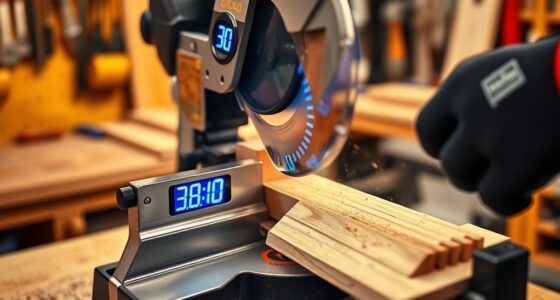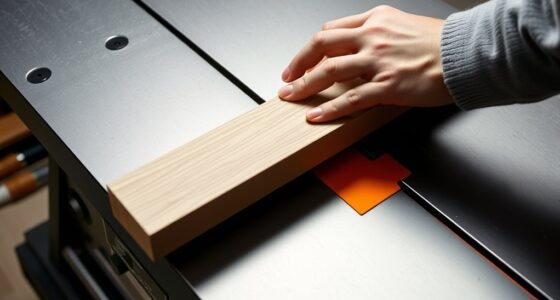

To use a shooting board for perfect ends, secure your workpiece firmly against the fence, making sure the grain runs correctly to avoid tear-out. Keep your plane steady and at a consistent angle, applying smooth, even pressure as you slide along the workpiece. Check squareness regularly with a square or straightedge and make minor adjustments as needed. Mastering these steps will help you achieve clean, square edges consistently—continue exploring these techniques to improve your results even further.
Key Takeaways
- Secure the workpiece firmly against the fence to ensure accurate, square cuts.
- Align the grain direction properly before cutting to prevent tear-out and achieve cleaner edges.
- Use steady, even pressure with a shooting plane for straight, controlled cuts.
- Check the squareness after each cut with a square or straightedge, adjusting as needed.
- Lightly sand or plane edges beforehand to ensure smooth movement along the shooting board.

Ever wondered how to achieve perfectly squared and smooth ends on your woodworking projects? Using a shooting board can make all the difference. It’s a simple yet effective tool that helps you cut and trim your workpieces to precise dimensions, guaranteeing clean, square edges every time. To get the best results, you need to pay attention to a couple of key factors: grain direction and edge preparation. These details might seem minor, but they play a crucial role in achieving that professional finish.
First, understanding the grain direction of your wood is essential. Always examine your board before making your cut. Cutting against the grain can cause tear-out, leaving rough or jagged edges. When you set up your shooting board, align the face of your workpiece so that you’re cutting along or with the grain, not against it. This minimizes tear-out and results in a smoother, cleaner cut. When you follow the grain direction, your cuts will be neater, and your edges will be easier to sand or finish later on. Properly aligning your workpiece relative to the grain also makes edge preparation more straightforward, as you’ll have fewer imperfections to correct. Additionally, selecting the right cutting tools and maintaining their sharpness is vital for achieving precise results.
Edge preparation is another vital step before using the shooting board. Ensure that the edge of your workpiece is free of splinters, dents, or any other imperfections. If needed, lightly sand or plane the edge to remove rough spots, creating a flat, smooth surface. A well-prepared edge will glide smoothly against the shooting board’s fence, resulting in a precise, square cut. If your edge is uneven or rough, it can cause the workpiece to shift or bind, leading to inaccuracies. Taking a few moments to prepare the edge thoroughly ensures that the shooting process is smooth and controlled, giving you consistent results.
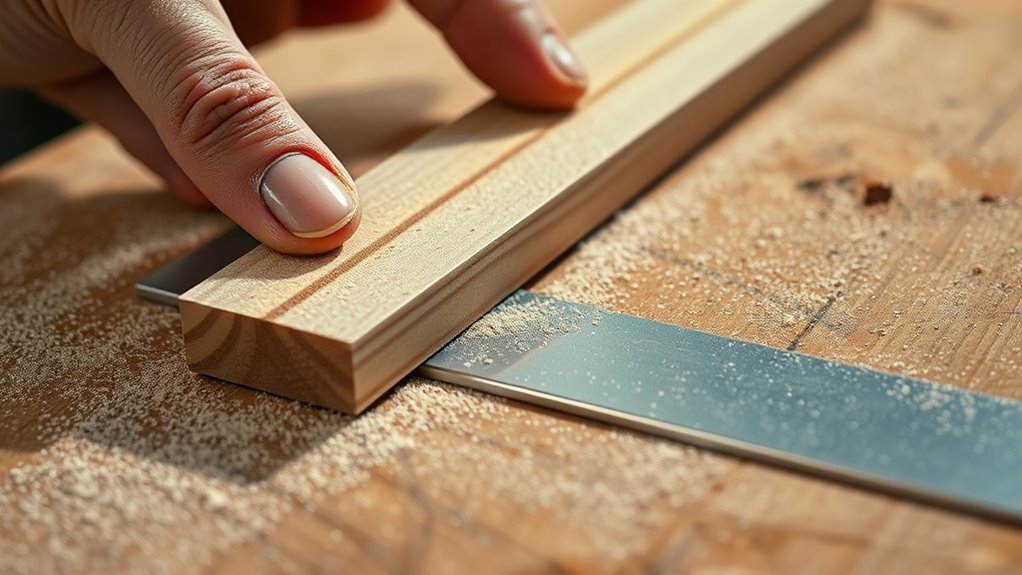
When you’re ready to use the shooting board, secure your workpiece firmly against the fence, keeping it aligned with your intended cut. Use steady, even pressure as you run a block plane or a shooting plane along the edge. Keep the tool at a consistent angle, and make sure your cut is straight and controlled. Applying consistent pressure and moving smoothly along the workpiece helps produce a perfectly squared end with a crisp, smooth surface. After the cut, check the edge for squareness using a square or straightedge. If needed, make minor adjustments with the plane to perfect the end. Over time, this process becomes intuitive, and you’ll consistently achieve professional-quality results.

Dowel Jig, Matework Adjustable Width Doweling Jig for Woodworking, Biscuit Joiner with Imperial Side Scales for Centering, Drill Guide for Straight Holes Dowel Jig Kit with 3 Drill Bits & 3 Stop Rings
【Adjustable Width】The doweling drill jig woodworking accommodates boards from 3/8" to 1-3/4" thick, with adjustment via rotation of...
As an affiliate, we earn on qualifying purchases.
Frequently Asked Questions
Can I Use a Shooting Board for Softwoods Only?
You can definitely use a shooting board for softwoods, as it’s ideal for achieving precise, clean ends regardless of wood type. Softwoods like pine or cedar cut well with this tool, using a smooth, steady cutting technique. Just guarantee your blade is sharp and set at the right angle. For harder woods, be more cautious and possibly adjust your technique, but overall, shooting boards work great for softwoods to get perfect ends.
What Safety Precautions Should I Take When Using a Shooting Board?
You should always wear safety gear like goggles and a dust mask to protect yourself from wood chips and dust. Use proper technique by keeping your fingers well away from the blade and securing the wood firmly on the shooting board. Always check that the blade is sharp and securely mounted. Taking these precautions minimizes the risk of injury and guarantees a safer, more accurate cut every time.
How Do I Adjust the Shooting Board for Different Thicknesses?
To modify the shooting board for different thicknesses, you should start by adjusting the blades to match the desired cut. Then, set the angles accordingly to guarantee precise cuts. Use a measuring tool to verify the thickness and make incremental adjustments to the blades and angle settings until you achieve the perfect fit. Consistently check your work to maintain accuracy and safety during the process.
Is a Shooting Board Suitable for Large or Thick Stock?
A shooting board is perfect for large stock and thick material, but it might feel like a beast to handle. You can still get great results if you secure your large or thick pieces well and adjust the stops accordingly. For really hefty stock, consider using a sturdier, larger shooting board or a specialized jig to guarantee safety and precision. It’s all about adapting your setup to tackle those challenging pieces confidently.
How Do I Maintain and Clean My Shooting Board?
To maintain and clean your shooting board, regularly check blade alignment to guarantee precise cuts. Keep the surface free of dust, wood shavings, and debris by wiping it down with a damp cloth after each use. Occasionally, lightly sand the surface to maintain smoothness. Proper surface maintenance prevents rough cuts, while keeping the blade aligned ensures consistent accuracy, helping your shooting board perform at its best over time.

Rockler 3/8” Doweling Jig Kit w/Drill Bit & Stop Collar – Wood Dowel Jig kit – Dual Edge Stops for Easy Alignment w/Dovetail – Durable Nylon Jig w/Steel Bushings – Dowel Jointer Jig w/Hex Wrench
Dowel Jig Kit: Position your work pieces exactly as they will be when joined. Our 3/8” joiner woodworking...
As an affiliate, we earn on qualifying purchases.
Conclusion
Using a shooting board guarantees your end grains are consistently smooth and precise, giving your projects a professional finish. Did you know that woodworking enthusiasts report achieving perfectly squared ends in 90% of their cuts with a shooting board? That’s a huge boost in accuracy and quality. So, next time you’re aiming for flawless edges, remember this simple tool can make all the difference—saving you time, frustration, and perfecting your craft every time.

Beaiguna Self Centering Dowel Jig Kit, Drill Guide Jig Block for Straight Holes with 6PCS Drill Bushings, Premium Self Centering Doweling Jig Kit for Woodworking, Adjustable Width Biscuit Joiner Tool
FLEXIBLE ADJUSTMENT: Our wood dowel jig can clamp a wide range of wood blocks from 0.4 to 2...
As an affiliate, we earn on qualifying purchases.

HITOMEN Adjustable Doweling Jig Kit with 5 Drill Sleeves (6/8/10mm) for Precise Dowel Hole Drilling in Woodworking
【PRECISION】Self-centering drill guide and adjustable right angle tool allow for precise doweling and enhanced joint strength. When drilling,...
As an affiliate, we earn on qualifying purchases.