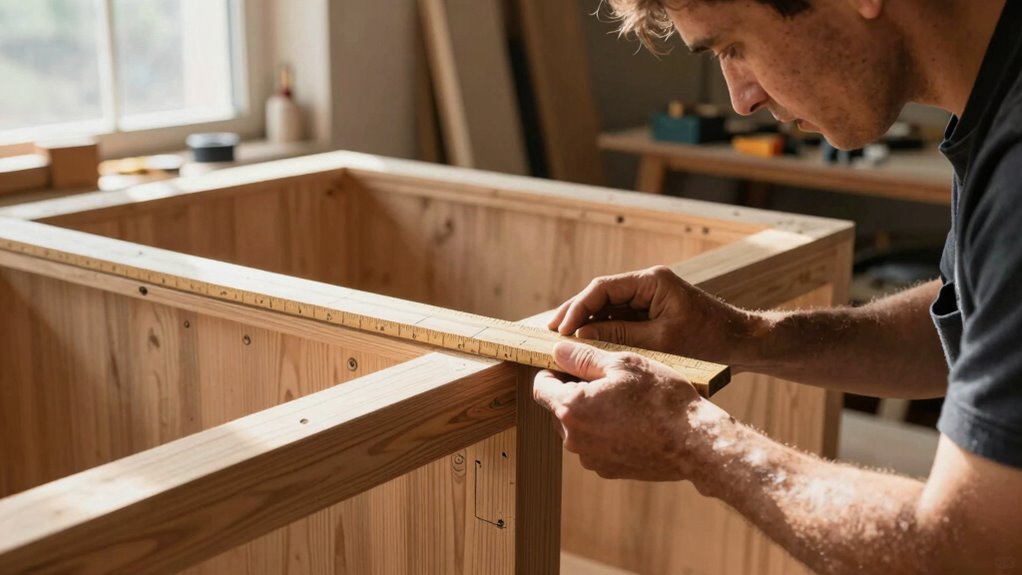

To stop measuring twice, create a sturdy story stick marked with all key cabinet measurements. Hold it against your workpieces to quickly transfer dimensions, reducing the need to re-measure each time. This approach speeds up your workflow, improves accuracy, and helps guarantee consistent cuts for all parts. Using a well-made story stick keeps your project on track and minimizes errors. Keep going to discover how to make and use one effectively for faster cabinet making.
Key Takeaways
- A story stick streamlines measurement transfer, reducing the need for repeated measuring during cabinet construction.
- It ensures consistent cuts and fit across multiple cabinet components, saving time and minimizing errors.
- Made from durable, accurately marked materials, a story stick provides a quick reference for all key measurements.
- Using a story stick eliminates reliance on multiple measuring tools, accelerating the assembly process.
- Double-checked and precisely scaled, a story stick promotes faster, more accurate cabinet building with less rework.

Using a story stick can substantially speed up your cabinet-making process by providing a simple, effective way to transfer measurements accurately. When you’re working on cabinets, measuring mistakes can lead to wasted time and materials. That’s where a story stick becomes one of your most valuable woodworking tools. Instead of constantly measuring and re-measuring, you create a durable stick that captures all the essential dimensions of your project. Once your measurements are marked on the stick, you can quickly transfer those measurements to different pieces, ensuring consistent cuts and fit. This approach not only saves time but also greatly improves measuring accuracy, minimizing errors caused by misreading or forgetting measurements.
With a story stick, you eliminate the need for repeated measurements, which often introduce inaccuracies. You simply mark the stick once with the key measurements—height, width, spacing, and angles—and then use it as your reference for each cut. This method is especially beneficial when you’re working on multiple identical components, such as cabinet sides or shelves. Instead of juggling multiple measuring tapes, rulers, or squares, you rely on the stick to maintain uniformity throughout the project. This reduces your reliance on multiple woodworking tools, streamlining your workflow and making the process more efficient.
Additionally, using a story stick aligns with principles of efficient woodworking by reducing the chance of measurement errors caused by imprecise tools or techniques. The key to maximizing the effectiveness of a story stick is to make it precisely to scale and clearly mark all necessary measurements. Use a sturdy, straight piece of wood or a durable material that won’t warp over time. When marking your measurements, be precise and double-check your figures. Once the stick is ready, it becomes a quick reference guide that you can hold up to your workpieces or lay alongside them. This method ensures that your measurements stay consistent, especially when cutting or assembling, leading to tighter joints and a cleaner finish.

Woodpeckers SSPRO-96 Story Stick Pro-96 – Imperial Scale
Story Sticks For Flawless, Repeatable Full-Scale Layout Marking And Measuring
As an affiliate, we earn on qualifying purchases.
As an affiliate, we earn on qualifying purchases.
Frequently Asked Questions
Can a Story Stick Be Used for Other Woodworking Projects?
Yes, you can definitely use a story stick for other woodworking projects. It helps maintain measuring accuracy across various tasks, ensuring consistent cuts and fits. Plus, using a story stick can improve woodworking safety by reducing repeated measurements and handling tools more confidently. Whether you’re building shelves, furniture, or frames, a story stick streamlines your process, saves time, and keeps your project safer.
What Materials Are Best for Making a Durable Story Stick?
You should choose hardwoods like oak, maple, or cherry for making a durable story stick, as they resist wear and tear well. Opt for a finish like polyurethane or varnish to protect the surface and guarantee longevity. Avoid softwoods that may dent or splinter easily. By selecting quality wood and applying a suitable finish, your story stick will stay accurate and intact through many projects.
How Do I Ensure Consistent Measurements With a Story Stick?
Imagine you’re building cabinets and want perfect consistency. To guarantee this, regularly check your story stick for any damage or wear, since tool accuracy affects measuring techniques. Mark measurements clearly and double-check each time before use. For example, a carpenter who maintains a clean, well-marked story stick reports fewer errors and faster work. Consistent measurements rely on careful tool maintenance and disciplined measurement techniques.
Is a Story Stick Suitable for Professional Cabinet Makers?
Yes, a story stick is suitable for professional cabinet makers. It enhances measuring accuracy by providing a consistent reference, reducing errors. Using a story stick also improves tool efficiency by speeding up the process, as you don’t need to measure repeatedly. Professionals benefit from its reliability and speed, making it an essential tool for precise, quick, and consistent cabinet construction.
How Do I Store and Maintain My Story Stick Between Projects?
Imagine your story stick as a treasured family heirloom—carefully stored and cherished. To keep it in prime shape, use storage tips like hanging it on a dedicated hook or storing it in a protective sleeve. Maintain it with regular routines such as cleaning off dust and checking for splinters. This way, your story stick stays accurate and ready, making your cabinet projects faster and more precise every time you pick it up.

WIN TAPE Workbench Ruler Adhesive Backed Tape Measure – 24 Inches 61 Centimeters Tape Measure (Right to Left – Inches/cm)
Material: 100% eco-friendly material.
As an affiliate, we earn on qualifying purchases.
As an affiliate, we earn on qualifying purchases.
Conclusion
Think of a story stick as your guiding compass in cabinet making. It keeps your measurements steady and your workflow smooth, so you’re not constantly second-guessing or re-measuring. With this trusty tool, you’ll build faster, like a ship sailing steadily through calm waters. Embrace the story stick, and watch your projects become more efficient and enjoyable—making each cut and joint as precise as a well-told story, straight from start to finish.

Draxzor 3PCS Woodworking Ruler Set, Precision Pocket Ruler with Adjustable Slide Stop, Aluminum Alloy Measuring Tool for Marking & Scribing, Metal T-Track Square Rulers, Inch and Metric (6", 8", 12")
【All-in-One Marking Kit】Includes 3 precision rulers (6", 8", 12") with sliding stop blocks—ideal for accurate layout, repeatable cuts,…
As an affiliate, we earn on qualifying purchases.
As an affiliate, we earn on qualifying purchases.

Extendable Measuring Stick Tool | Pinch Stick for Woodworking | No Numbers, No Mistakes | Carpentry, Woodworking, Hobbies, and Remodeling Projects.
Cut perfect-fitting trim for molding, windows, floors, walls.
As an affiliate, we earn on qualifying purchases.
As an affiliate, we earn on qualifying purchases.