Dial indicators are essential tools for achieving precise saw alignments in woodworking. By accurately measuring blade position and ensuring everything is perfectly level, you can make professional-grade cuts every time. Proper calibration and choosing trusted brands like Mitutoyo or Starrett help maintain accuracy and reliability. Using dial indicators might seem tricky at first, but with the right technique, you’ll improve your setup skills markedly. Keep going, and you’ll discover how to make your woodworking projects even more accurate and flawless.
Key Takeaways
- Use dial indicators to accurately measure and align saw blades, ensuring precise cuts and improved project quality.
- Regularly calibrate your dial indicator on a flat surface or precision block for consistent, reliable readings.
- Choose reputable brands like Mitutoyo or Starrett for durability, accuracy, and long-term dependability in woodworking.
- Proper calibration and quality tools reduce measurement errors, leading to cleaner cuts and better saw alignment.
- Mastering calibration techniques with dial indicators transforms your saw setup from basic to professional-grade precision.
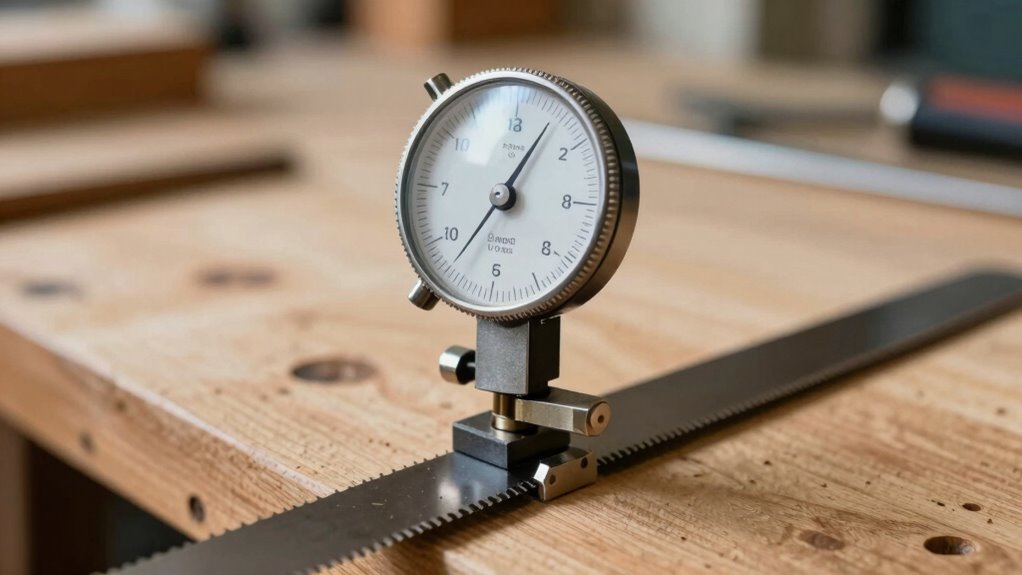
When precision matters in woodworking, dial indicators become essential tools for achieving accurate measurements. Whether you’re aligning a saw blade, setting up a router, or fine-tuning your workbench, a dial indicator helps you obtain the exact measurements needed for professional results. To maximize their accuracy, it’s vital to understand proper calibration techniques. Calibration involves checking and adjusting the dial indicator against a known standard to guarantee it reads correctly. You can do this by placing the dial indicator on a flat, stable surface or a precision block and gently moving the probe to verify the readings. If discrepancies are found, many models allow you to zero the dial or adjust the bezel to correct the measurement. Regular calibration is key, especially if you’re using your dial indicator frequently or after transportation, as even slight impacts can alter its accuracy. Investing time in calibration techniques ensures consistent, dependable measurements that keep your woodworking projects on point. Additionally, understanding the accuracy standards of your dial indicator can help you select the right model for your needs and maintain precise results over time.
When it comes to choosing a dial indicator, the best brands stand out for their reliability, durability, and precision. Brands like Mitutoyo, Starrett, and Fowler are highly regarded among woodworking enthusiasts and professionals alike. Mitutoyo offers a range of high-quality, precise models that are known for their durability and consistent performance, making them a top choice for those who demand accuracy. Starrett, another trusted name, produces robust dial indicators built to withstand tough workshop environments, ensuring long-term reliability. Fowler provides more budget-friendly options without sacrificing quality, making them ideal for hobbyists or those new to using dial indicators. Whichever brand you choose, guarantee it offers features suitable for woodworking tasks, such as easy-to-read dials, smooth movement, and a sturdy frame. The right brand, combined with proper calibration techniques, guarantees you’ll have a dependable tool that helps you achieve perfect saw alignments and precise cuts every time.
Using a dial indicator might seem straightforward, but mastering calibration and selecting the best brands can greatly impact your results. When you take the time to calibrate your tool correctly, you eliminate measurement errors that could compromise your project’s quality. Opting for trusted brands ensures you get a reliable instrument that will serve you well through countless projects. With the right approach, your woodworking setup becomes more precise, allowing you to create flawless cuts and alignments. Whether you’re setting up a table saw or fine-tuning a miter gauge, understanding calibration techniques and choosing top brands puts you in control. This investment in accuracy not only improves your craftsmanship but also saves you time and materials in the long run. Ultimately, a dial indicator is a small but powerful tool that, when used correctly, transforms your woodworking from good to professional-grade.

WEN 10703 1 in. Precision Dial Indicator with .001 in. Resolution
Meets ASME and ANSI standards
As an affiliate, we earn on qualifying purchases.
As an affiliate, we earn on qualifying purchases.
Frequently Asked Questions
Can Dial Indicators Be Used for Measuring Angles?
Yes, dial indicators can be used for angle measurement in woodworking. They help you precisely check and set bevel alignment, ensuring your cuts are accurate. By attaching a dial indicator to your workpiece or tool, you can measure small deviations and fine-tune your saws or jigs. This makes it easier to achieve perfect angles, especially for intricate joints or complex cuts, giving you professional-quality results every time.
What Is the Best Type of Dial Indicator for Beginners?
As a beginner, you should choose a dial indicator with good precision accuracy and simple measurement calibration features. A mechanical dial indicator with a range of 0-1 inch and a 0.001-inch resolution offers reliable measurements without complexity. This type helps you develop your skills, guarantees consistent results, and provides clear readings. It’s user-friendly and perfect for honing your woodworking skills, especially when aligning saws and other tools accurately.
How Often Should I Calibrate My Dial Indicator?
Think of your dial indicator as a finely tuned instrument in your woodworking symphony. You should calibrate it regularly—preferably before each major project or monthly—to keep its precision sharp. Follow maintenance tips like cleaning and storing it properly to prevent drift. This way, your measurements stay true, and your saws stay aligned, turning routine calibration into a safeguard for flawless craftsmanship every time you work.
Are Digital Dial Indicators More Accurate Than Analog Ones?
Digital dial indicators often offer greater digital precision, making them more accurate for detailed woodworking tasks. They display measurements clearly and can be easier to read, especially in tight spaces. However, analog simplicity means they’re durable and don’t rely on batteries. If you prefer straightforward, reliable tools, an analog dial indicator works well. But for high accuracy and ease of use, digital options are generally better.
Can Dial Indicators Measure Depth or Only Linear Movement?
Dial indicators can measure both depth and linear movement, making them versatile tools for woodworking. When you use them for depth measurement, they provide precise readings of how deep a cut or slot is, ensuring accuracy. For linear accuracy, dial indicators help you align your saws and blades perfectly, so you get clean, straight cuts every time. Their ability to measure different types of movement makes them essential for high-precision woodworking projects.

Neoteck 0-1'' Digital Dial Indicator Table Saw Gauge Suitable for Table Saws with a Groove Width of 3/4" (19mm) or More for Aligning and Calibrating Work,Shop Machinery,Band Saw and Drill Press-Black
【Professional Table Saw Gauge】Neoteck table saw gauge is designed according to the standard miter grooves(3/8 inch x 3/4…
As an affiliate, we earn on qualifying purchases.
As an affiliate, we earn on qualifying purchases.
Conclusion
With a dial indicator in your toolkit, you’ll master saw alignment faster than a blacksmith at dawn. It’s like having a trusty compass on your woodworking journey, guiding you to perfect cuts and flawless results. Don’t let misalignment turn your project into a mess—embrace this secret weapon and work with precision. Before you know it, you’ll be slicing through wood with the skill of a seasoned craftsman, just like the artisans of old who valued craftsmanship above all.

Mitutoyo "2416S" Dial Indicator, #4-48 UNF Thread, 0.375" Stem Dia., "Lug Back," White Dial, 0-100 Reading, 2.244" Dial Dia., 0-1" Range, 0.001" Graduation, +/-0.002" Accuracy
Standard dial indicator with a 0.375" diameter stem, a #4-48 UNF contact point thread mount, and choice of…
As an affiliate, we earn on qualifying purchases.
As an affiliate, we earn on qualifying purchases.

Starrett 25 Series Dial Indicator with Jewel Bearings and Lug-On-Center Back – White Face, 0-1.000" Range, 0-100 Dial Reading, .001" Graduation – 25-441J
Made From Robust Materials – This Dial indicator is made of unbreakable crystal, hardened stainless steel stem, gears…
As an affiliate, we earn on qualifying purchases.
As an affiliate, we earn on qualifying purchases.