
To calculate board feet, measure your lumber’s length, width, and thickness in inches, then apply the formula: (Thickness x Width x Length in feet) divided by 12. To account for waste, add an extra 10-15% to your total. Use precise measurements and consider grading to select the best wood for your project. Keep these tips in mind, and you’ll be ready to determine accurate quantities and waste factors effectively. If you continue, you’ll find more helpful details to optimize your process.
Key Takeaways
- Calculate board feet using the formula: (Thickness x Width x Length in feet) divided by 12.
- Measure lumber dimensions accurately to ensure precise board foot calculations.
- Add an extra 10-15% to the total board feet to account for waste during cutting and processing.
- Incorporate waste factors into your calculations to prevent underestimating material needs.
- Utilize digital measuring tools and sustainable sourcing practices to improve accuracy and reduce material loss.

Wondering how to accurately measure wood for your project? It’s a crucial step that ensures you buy the right amount of material without wasting money or resources. When calculating board feet, understanding the role of sustainable forestry is essential. Sustainable forestry practices promote responsible harvesting, ensuring that the forest remains healthy and productive for future generations. By sourcing wood from sustainably managed forests, you actively support environmental conservation and help reduce deforestation. This approach also influences the quality of the lumber you receive, as sustainably harvested wood often adheres to higher standards of care and processing.
Accurately measuring wood ensures responsible sourcing and better project quality.
Lumber grading plays a vital role in determining the value and quality of the wood you’re purchasing. Grading systems categorize lumber based on factors like knots, splits, and overall appearance, helping you assess how much usable material you’ll get from each board. Higher-grade lumber usually has fewer defects and is more suitable for visible applications, while lower grades may be perfect for framing or other structural uses. Knowing how to interpret grading labels allows you to avoid overestimating or underestimating your needs, ensuring your project stays within budget and meets quality expectations.
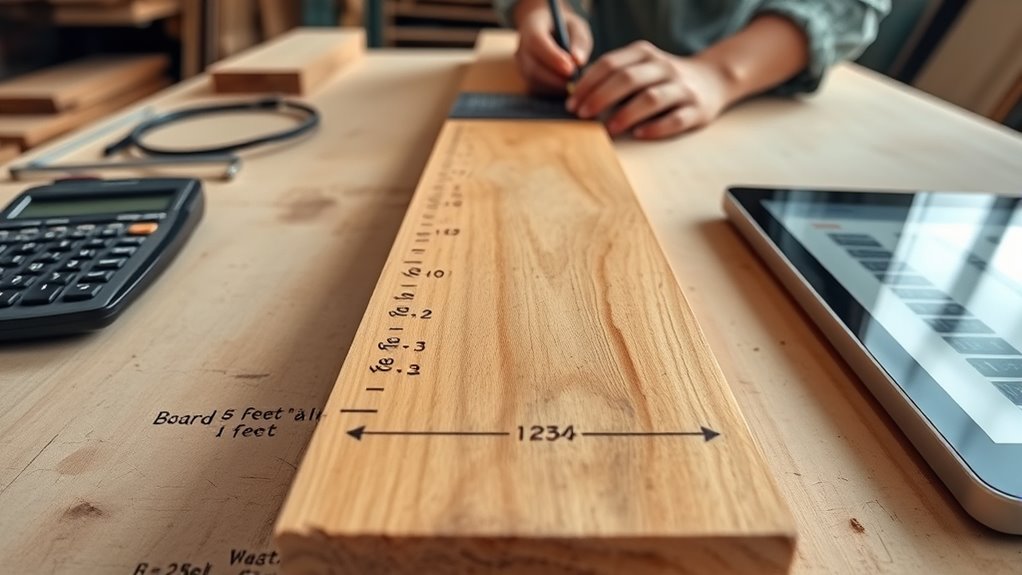
To start calculating board feet, measure the dimensions of your lumber precisely. Take the length, width, and thickness of each board in inches. The standard formula for board feet is: (Thickness in inches x Width in inches x Length in feet) divided by 12. This calculation gives you the number of board feet each piece contains. Keep detailed records of your measurements to prevent errors, especially if you’re working with multiple boards of varying sizes. Accurate measurements help you order the right amount of wood early on, reducing waste and additional trips.
Additionally, using appropriate technology such as digital measuring tools can improve accuracy and efficiency in your calculations. Remember that waste factors are part of the equation too. Not every cut will be perfect, and some material will inevitably be lost during processing or fitting. Incorporate a waste factor—typically around 10% to 15%—to account for these losses. This ensures you buy slightly more wood than your calculations suggest, avoiding shortages during construction. When sourcing your lumber, look for suppliers who practice sustainable forestry, as this supports eco-friendly practices and often leads to better quality wood. Additionally, pay attention to lumber grading to select the appropriate type of wood for each phase of your project, maximizing efficiency and minimizing waste.

ansigtny 2-in-1 Laser Tape Measure, 197Ft Laser Measuring Tool & 16Ft Measuring Tape with M/in/Ft/Ft+in Units, Magnetic Hook – Pythagorean, Area, Volume, Digital Tape Measure for Woodworking and DIY
NOTE: The screen displayed is the distance of the laser ( 197Ft ), NOT TAPELINE -The 16Ft TAPE…
As an affiliate, we earn on qualifying purchases.
As an affiliate, we earn on qualifying purchases.
Frequently Asked Questions
How Do Waste Factors Vary Between Different Wood Species?
Waste factors vary between wood species because of species variability in grain, density, and cutting characteristics. You need to make processing adjustments based on these differences to guarantee accurate board foot calculations. For instance, hardwoods often have higher waste factors than softwoods due to more complex grain patterns. By recognizing species variability, you can better estimate waste and optimize your processing, reducing material loss and improving efficiency.
Can Board Feet Calculations Be Automated With Software Tools?
Yes, you can automate board feet calculations using automation tools and software applications. These tools streamline the process by inputting measurements and dimensions, then automatically computing board feet, reducing errors and saving time. Many software options also account for waste factors and wood species variations, making your calculations more accurate. Embracing automation tools allows you to improve efficiency and guarantee precise estimates, especially when handling large volumes or complex projects.
What Environmental Factors Affect Waste Percentages During Processing?
Environmental factors are the winds that steer your waste percentages during processing. You need to navigate carefully, especially with sustainable harvesting and environmental regulations shaping your course. Humidity, temperature, and wood species can either swell or shrink the wood, affecting waste. Pollution levels and air quality also play roles, making it essential to stay vigilant. By managing these factors, you reduce waste and stay compliant with regulations, ensuring a more efficient process.
How Does Moisture Content Influence Board Foot Measurements?
Moisture content impacts your board foot measurements by affecting measurement accuracy. When wood has high moisture, it appears larger and heavier, leading you to overestimate the board feet. Conversely, dry wood shrinks, causing you to underestimate. To confirm precise calculations, you must account for moisture impact. Properly dried and moisture-adjusted measurements help you make better decisions, reduce waste, and maintain consistent quality in your processing.
Are There Regional Differences in Standard Waste Factors?
Yes, regional variations in waste factor standards exist because different areas have unique wood species, harvesting practices, and processing methods. You should consider these differences when estimating waste, as some regions might have higher waste factors due to more extensive bark or defect inclusion. Understanding local standards helps you make more accurate calculations, ensuring your estimates reflect regional practices and reduce surprises during processing or final measurement.

Lumber Calculators Pro
Green Lumber Weight calculator for variety of wood species
As an affiliate, we earn on qualifying purchases.
As an affiliate, we earn on qualifying purchases.
Conclusion
So, after all this effort to calculate board feet and waste factors, you’d think it’s straightforward. But here’s the irony—you can measure every inch perfectly, yet a tiny mistake or unforeseen waste can throw off your entire project. It’s a reminder that no matter how precise you get, some things are just out of your control. So, double-check your math, but don’t be too surprised if a little chaos still sneaks in.

Clarke Brothers Wheel Marking Gauge – Woodworking Marking Scriber Kit With 2 Replacement Cutters – Wood Marking Tools With Graduated Inch & MM Scale – Solid Metal Bar Wood Scribe Tool For Carpenter
✅ PATENT PENDING – ROLL STOP FENCE WITH FLAT SPOT – woodworking tasks with a high-end wheel marking…
As an affiliate, we earn on qualifying purchases.
As an affiliate, we earn on qualifying purchases.

A Landowner's Guide to Managing Your Woods: How to Maintain a Small Acreage for Long-Term Health, Biodiversity, and High-Quality Timber Production
As an affiliate, we earn on qualifying purchases.
As an affiliate, we earn on qualifying purchases.