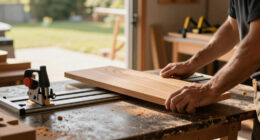
Using an angle-finder is the secret to making perfect miter joints easily. It helps you measure exactly the angles of your cuts, so you can transfer them directly to your saw without guesswork. With this tool, you’ll get precise, tight-fitting joints every time and save time correcting mistakes. It’s versatile for all projects, from crown molding to furniture. Keep going, and you’ll discover how this simple shortcut transforms your woodworking results.

Get business pricing on tools and workshop supplies
- Business-only prices and quantity discounts
- Tax-exempt purchasing
- Multiple users, one account, clear invoices
Key Takeaways
- Use an angle-finder to accurately measure and transfer angles directly to your saw for perfect miters.
- Lock the angle-finder in place to ensure consistent and repeatable cuts.
- Measure the angle on your material, then quickly transfer it to your miter saw for precise cuts.
- Digital angle-finders offer multiple measurement modes for versatile and accurate miter setups.
- Incorporating an angle-finder reduces guesswork, ensuring tight-fitting joints and professional-looking results.

Achieving perfect miter joints can be challenging, but with the right tools and techniques, you can simplify the process considerably. One game-changer is using an angle-finder, which dramatically improves measuring accuracy and highlights the versatility of your toolkit. When you’re cutting angles for frames, moldings, or trim work, precision is everything. Small miscalculations can lead to gaps or misaligned joints, wasting time and materials. An angle-finder helps you get it right the first time, ensuring your cuts are exact and your joints fit seamlessly. Incorporating proper measurement techniques into your workflow further enhances the accuracy and quality of your projects.
Measuring accuracy is essential, and traditional methods like protractors or guesswork often fall short. An angle-finder allows you to quickly and precisely determine the exact angle needed for your project. Instead of relying on rough measurements or complex calculations, you simply position the tool against the piece, read the angle, and transfer that measurement directly to your saw. This straightforward approach minimizes errors caused by inconsistent measuring techniques, so you can trust that your cuts will align perfectly. With improved measurement accuracy, you reduce waste and save time, making your work more efficient and professional-looking.
Tool versatility is another key benefit of using an angle-finder. Many models are designed to adapt to different tasks, whether you’re working with crown molding, framing, or custom furniture. Some angle-finders are digital, offering easy-to-read displays and multiple measurement modes, while others are manual but equally precise. You can use them on various surfaces and materials, and many are compact enough to carry around your workspace easily. This adaptability means you don’t need multiple specialized tools—your angle-finder can handle a wide range of projects, helping you become more efficient without cluttering your toolbox.
Using an angle-finder is simple. Place it against the surface you’re measuring, read the angle, then transfer that measurement to your saw or miter box. Some models even allow you to lock in the measurement, so you can transfer it accurately without worrying about shifting or misreading. This consistency is especially valuable when making multiple cuts, as it ensures each piece matches perfectly. By integrating an angle-finder into your workflow, you gain confidence in your measurements, resulting in tight-fitting joints that look professional and require less finishing work.
Products Worth Considering
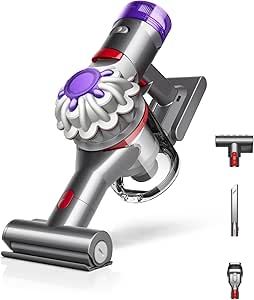
Dyson Car+Boat Cordless Handheld Vacuum

Blueair Blue Pure 211i Max Air Purifier

iRobot Roomba Max 715 Pet Robot Vacuum with AutoEmpty Dock
As an affiliate, we earn on qualifying purchases.
Frequently Asked Questions
Can the Angle-Finder Be Used for Non-Wood Materials?
You might wonder if the angle-finder can be used for non-wood materials. The good news is, it offers great material versatility and works well with various materials like plastic, metal, or ceramics. Its precision makes it ideal for non-wood applications too. Just make certain you handle different surfaces carefully and adjust your technique accordingly. This tool’s versatility truly extends beyond just wood, making it a valuable addition to your toolkit for diverse projects.
What Is the Maximum Angle Measurement the Tool Can Handle?
You wonder about the tool’s capacity for angle measurement, and it typically handles up to 180 degrees, covering most common woodworking needs. This means you can measure and mark straight lines, sharp corners, or wide angles confidently. The tool’s capacity guarantees versatility, helping you achieve precise cuts for various projects. With this range, you’re equipped to tackle everything from simple miter joints to complex angled cuts effortlessly.
Is Any Calibration Needed Before Each Use?
Before each use, you should perform a quick calibration process to verify accuracy. While some angle finders require daily adjustments, many modern tools are designed to stay calibrated for extended periods. Check the manufacturer’s instructions, but generally, a simple calibration before starting your project helps maintain precision. This small step guarantees your measurements are reliable, making your miter cuts perfectly accurate every time.
How Durable Is the Angle-Finder in Prolonged Use?
You might wonder about the durability of the angle‑finder during prolonged use. Its material durability and wear resistance are designed to withstand frequent handling, so it holds up well over time. The sturdy construction ensures it won’t easily warp or break, maintaining accuracy with regular use. Just avoid harsh impacts or extreme conditions, and it’ll serve you reliably, making those perfect miters easier every time you work on your projects.
Are There Alternative Tools for Achieving Perfect Miters?
When aiming for perfect miters, you might wonder about alternative methods. Traditional techniques like using a miter box or a protractor can be effective, especially for simple cuts. You can also opt for digital angle gauges or jigs that guarantee precision. These tools offer reliable results if you prefer to avoid or supplement the angle-finder. Ultimately, choosing the right method depends on your project’s complexity and your comfort level with each tool.
Conclusion
With this angle-finder shortcut, creating perfect miter joints becomes as easy as snapping together building blocks. No more guesswork or frustrating adjustments—just accurate cuts every time. Think of it like having a secret weapon in your toolkit, turning complex tasks into simple steps. Now, you can confidently tackle your projects, knowing that precision is within your grasp. Before long, your finished work will look as polished as a professional’s, making your woodworking truly stand out.