Understanding plywood grades and cores helps you select the right material for your project. Plywood grades like A, B, and C indicate the surface quality, with A being smooth and defect-free, ideal for visible finishes. Core types such as veneer, plywood, or composite affect strength, stability, and weight. Knowing how these factors influence durability and appearance guarantees your finished work meets expectations. Keep exploring to discover how to select the best plywood for your needs.
Key Takeaways
- Plywood grades (A, B, C) indicate veneer surface quality, affecting appearance and finishing options.
- Core types (veneer, plywood, composite) influence strength, stability, weight, and environmental resistance.
- Higher-grade veneers have fewer imperfections, suitable for visible surfaces, while lower grades are often structural.
- Core construction impacts durability, resistance to warping, and suitability for specific applications.
- Choosing the right combination of veneer grade and core type ensures optimal performance and project longevity.

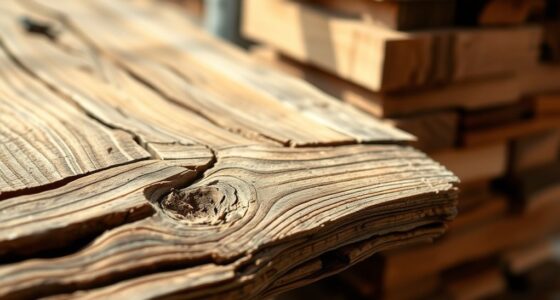
Understanding plywood grades and cores is essential when selecting the right material for your project. Your choice can markedly affect the appearance, durability, and overall performance of your finished product. To make an informed decision, you need to understand how veneer quality and core construction influence these factors. Veneer quality refers to the surface layers of the plywood, which determine how smooth, uniform, and attractive the final surface will be. Higher-grade veneers typically feature fewer knots, splits, or defects, making them ideal for visible projects like furniture, cabinetry, or decorative panels. Lower grades might have more imperfections but can still serve well for structural purposes where surface appearance isn’t as critical.
Choosing the right plywood involves considering veneer quality and core construction for optimal appearance and durability.
Core construction, on the other hand, involves the internal layers that hold the veneer together. The core type directly impacts the strength, stability, and weight of the plywood. There are several common core types, including veneer core, plywood core, and composite core. Veneer cores are made from thin sheets of veneer bonded together, providing a good balance of strength and smoothness. Plywood cores consist of strips of wood arranged in a cross-grain pattern, making the panel more resistant to warping and expansion. Composite cores, often made from particleboard or MDF, tend to be more economical but may lack the same resilience as veneer or plywood cores. Your project’s specific requirements will guide the choice among these core types.
When evaluating veneer quality, consider the grade designation assigned by industry standards. For example, A-grade veneers are the highest quality, featuring minimal defects and a smooth surface suitable for finishing. B and C grades may have more knots, blemishes, or splits, which can be filled or hidden depending on your project. The veneer quality directly impacts the final appearance, especially if the surface will be visible and finished with paint, stain, or veneer overlay.
Core construction also influences how well the plywood holds up over time. A well-constructed core provides stability, minimizing expansion, contraction, and warping with humidity changes. For projects requiring precision and longevity, opting for plywood with a veneer core or plywood core is advisable. These types tend to offer better structural integrity and surface stability, especially for furniture and cabinetry.
high quality plywood for furniture
As an affiliate, we earn on qualifying purchases.
As an affiliate, we earn on qualifying purchases.
Frequently Asked Questions
How Do Plywood Grades Affect Overall Durability?
Plywood grades directly influence its durability because higher grades typically feature tighter grain patterns and smoother surface finishes, making them more resistant to wear and moisture. When you choose a higher-grade plywood, you get better structural integrity and longevity, especially in demanding environments. Lower grades may have visible imperfections, affecting their strength and durability. So, by selecting the right grade, you guarantee your project withstands daily use and environmental factors.
Can Plywood Cores Be Customized for Specific Projects?
Yes, you can customize plywood cores to suit your project like tailoring a suit to fit perfectly. This design flexibility allows you to choose cores that enhance strength, stability, or moisture resistance, depending on your needs. By matching your core material with your project’s specific requirements, you guarantee ideal material compatibility. Custom cores act as the backbone of your project, giving you the stability and performance you need to succeed.
What Environmental Factors Influence Plywood Core Selection?
Environmental factors like moisture resistance and environmental durability heavily influence your plywood core selection. If your project is outdoors or exposed to high humidity, choose cores with enhanced moisture resistance to prevent warping or swelling. For long-term durability in varying conditions, opt for cores designed to withstand temperature fluctuations and exposure to elements. By considering these factors, you guarantee your plywood performs well and lasts longer in its specific environment.
Are There Specific Safety Considerations for Different Plywood Grades?
Are you aware of the safety considerations for different plywood grades? Fire resistance is vital, especially in areas prone to heat or flames, so choose fire-retardant grades to reduce risks. Also, consider indoor air safety—low-VOC or formaldehyde-free options help prevent health issues. Always verify the plywood’s safety certifications and proper ventilation requirements to protect yourself and others during installation and use.
How Does Manufacturing Process Impact Plywood Core Quality?
Manufacturing process directly impacts plywood core quality through factors like material selection, adhesive application, and pressing techniques. During plywood core manufacturing, strict adherence to core quality standards guarantees uniformity and durability. Poor manufacturing can introduce defects such as voids or delaminations, weakening the core. By following these standards and refining production methods, you can produce a high-quality core that enhances the overall strength and longevity of the plywood.
veneered plywood sheets
As an affiliate, we earn on qualifying purchases.
As an affiliate, we earn on qualifying purchases.
Conclusion
Think of plywood as a storybook, each grade and core a chapter revealing its true character. Your choice shapes the journey—smooth pages for elegance or rugged for strength. Remember, the core’s hidden layers symbolize resilience beneath the surface, just like life’s quiet depths. By understanding these symbols, you craft with intention, building not just structures but stories of durability and purpose. In every sheet, find the silent strength waiting to be uncovered.
structural plywood with veneer core
As an affiliate, we earn on qualifying purchases.
As an affiliate, we earn on qualifying purchases.
decorative plywood panels
As an affiliate, we earn on qualifying purchases.
As an affiliate, we earn on qualifying purchases.