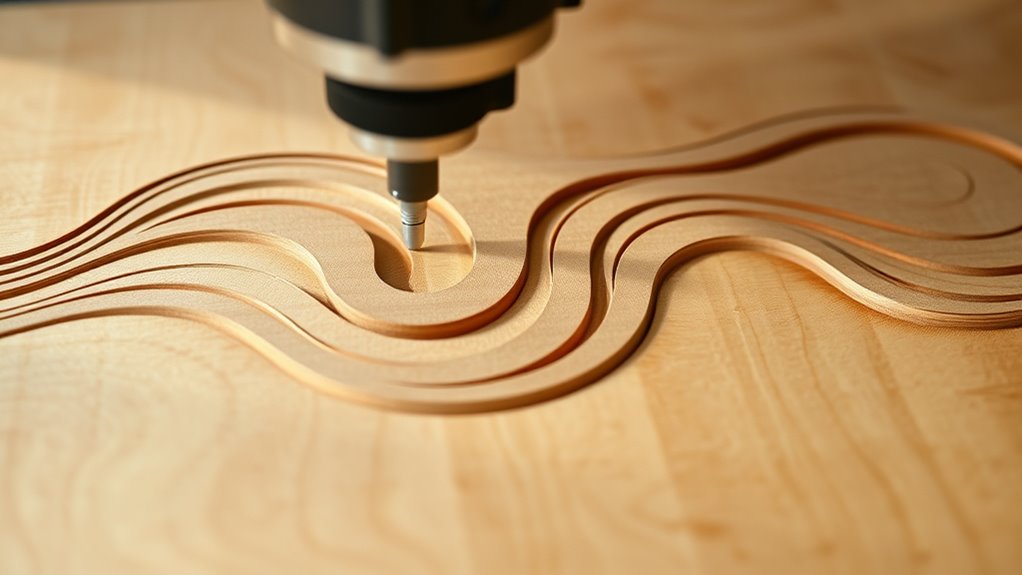

To create curves and organic shapes with CNC machines, you’ll want to choose soft, machinable materials like foam or plastics for smooth forms, or carefully plan with harder materials like metals. Use advanced CAM software to design seamless curves with tools like Bezier or spline algorithms, ensuring smooth progressions. Optimize your toolpaths by fine-tuning parameters like speed and depth, and simulate beforehand to avoid issues. Keep exploring to discover how combining material choice and software precision elevates your organic designs.
Key Takeaways
- Select soft, responsive materials like foam or plastics to facilitate smooth, organic forms during CNC machining.
- Use advanced CAM software to design and optimize tool paths for complex curves and natural shapes.
- Employ curve creation techniques such as Bezier and spline interpolation for seamless, flowing contours.
- Adjust machining parameters like feed rate and spindle speed to improve surface finish and prevent tool deflection.
- Simulate machining processes beforehand to identify issues, reduce waste, and ensure precise, organic-shaped outcomes.

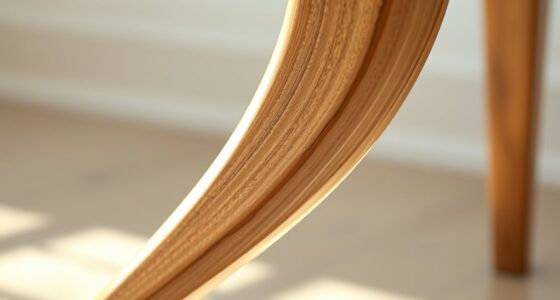
Creating curves and organic shapes with CNC machines opens up a world of design possibilities that were once difficult to achieve with traditional manufacturing methods. When working with complex geometries, your choice of material is vital. Not all materials respond equally to CNC machining, especially when crafting intricate curves. Softer materials like foam or certain plastics can be easier to shape, allowing for smooth, flowing organic forms. Harder materials, such as metals, require careful planning to avoid tool deflection or cracking, so selecting the right material guarantees your design’s precision and durability. Additionally, the material’s machinability influences the speed and quality of the finished piece, making informed material selection essential for peak results.
But material choice alone isn’t enough. You need to leverage software optimization to reveal the full potential of your CNC machine. Modern CAM (Computer-Aided Manufacturing) software offers powerful tools to plan tool paths that follow complex curves with high accuracy. By fine-tuning parameters like feed rate, spindle speed, and cutting depth, you can minimize tool wear and achieve smoother surface finishes. Software also allows you to simulate the machining process before actual cutting begins, helping you identify potential issues such as tool collisions or excessive material removal. This preemptive step saves time and reduces waste, guaranteeing your organic shapes come out as envisioned.
When designing curves, you’ll want to utilize software features that facilitate smooth transitions and natural contours. Bezier curves, spline interpolations, and other advanced algorithms help translate your artistic vision into precise tool paths. These tools enable you to create organic shapes that flow seamlessly, mimicking natural forms like waves, leaves, or biomorphic structures. As you prepare your design, pay close attention to the tool orientation and step-over settings within your software, as these directly impact the surface quality of complex shapes. The smoother the tool path, the better the finished product.
Combining thoughtful material selection with meticulous software optimization empowers you to craft stunning organic shapes with CNC machines. It’s about understanding the material’s properties, leveraging advanced software features, and fine-tuning your machine’s settings to produce curves that are both aesthetically pleasing and structurally sound. When you master these elements, you’ll find that CNC machining becomes an incredibly versatile tool for transforming your creative ideas into tangible, flowing forms that elevate your projects to new levels of craftsmanship.

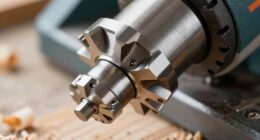
Amana Tool – 46566 Solid Carbide CNC Foam Down-Cut Cutting Square End Spiral 1/4 Dia x 2-1
Direction down-cut
As an affiliate, we earn on qualifying purchases.
As an affiliate, we earn on qualifying purchases.
Frequently Asked Questions
What Materials Are Best for Organic CNC Shapes?
For organic CNC shapes, you should choose materials like wood, foam, or acrylic because they offer great material selection for natural aesthetics. Wood, especially hardwoods, provides warmth and authenticity, while foam is easy to carve for complex curves. Acrylic adds a sleek, modern look with smooth finishes. These materials allow you to craft intricate, organic shapes efficiently, giving your project a natural, appealing appearance.
How Do I Prevent Tool Wear When Carving Curves?
Tool wear can be minimized by optimizing your tool paths to reduce unnecessary stress and heat buildup. Use coolant application strategically to keep the tool and material cool, preventing overheating and premature wear. Avoid aggressive cuts; instead, take lighter passes and maintain steady feed rates. By combining proper tool path optimization with effective coolant use, you’ll extend your tool’s lifespan and achieve smoother, more precise curves in your organic shapes.
Can CNC Machines Replicate Complex Natural Textures?
Yes, CNC machines can replicate complex natural textures by programming precise toolpaths that mimic natural patterns. You can achieve authentic textural replication by using advanced software to analyze and translate organic surface details into machine movements. Incorporate specialized tools or bit profiles to enhance the realism of natural textures. With careful calibration and detailed design, your CNC machine can produce highly intricate, natural-looking textures that add depth and authenticity to your projects.
What Software Is Ideal for Designing Organic Shapes?
You should consider using software like Fusion 360 or Grasshopper, which excel at designing organic shapes through generative design and parametric modeling. These tools let you easily manipulate complex curves, ensuring your designs are both precise and natural-looking. With real-time adjustments, you can refine your organic shapes quickly, making your CNC projects more innovative and tailored to your creative vision.
How Do I Ensure Smooth Finishes on Intricate Curves?
Think of your finish as a gentle river smoothing stones. To guarantee smooth finishes on intricate curves, you should employ finishing techniques like fine sanding and polishing. Use progressively finer sanding methods, starting with medium grit and moving to ultra-fine, to eliminate tool marks. Keep your tools aligned and consistent, and work slowly along the curves. This careful approach creates a seamless, polished surface that highlights your CNC’s organic shapes beautifully.
FUSION 360 CAM MADE SIMPLE FOR BEGINNERS 2026: Practical Techniques for CNC Machining, Toolpath Optimization, and Efficient 3D Workflows
As an affiliate, we earn on qualifying purchases.
As an affiliate, we earn on qualifying purchases.
Conclusion
So, now you’re a master of turning those pesky straight lines into flowing, organic shapes—who knew CNC machines had a secret wild side? With a little patience and some clever programming, you can create art that looks like it grew naturally, not just was carved out of a block. Just don’t forget to take a bow when your masterpiece fools everyone into thinking it’s been here for centuries. Happy shaping!
Bezier curve CNC software
As an affiliate, we earn on qualifying purchases.
As an affiliate, we earn on qualifying purchases.
FUSION 360 CAM MADE SIMPLE FOR BEGINNERS 2026: Practical Techniques for CNC Machining, Toolpath Optimization, and Efficient 3D Workflows
As an affiliate, we earn on qualifying purchases.
As an affiliate, we earn on qualifying purchases.