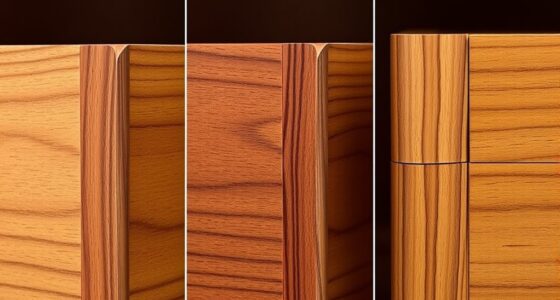
To build a simple jig for accurate cabinet hinge cup boring, start with a sturdy piece of plywood or MDF as your base. Mark precise measurements for the hinge positions and drill guide holes using a drill bit that matches your hinge cup diameter. Attach guide blocks or fences to ensure consistent placement, then clamp the jig securely to your cabinet door or frame. Fine-tune the setup with test holes, and with proper use, you’ll achieve perfect hinge alignment every time. Keep going to learn how to make your jig even more precise.

Get business pricing on tools and workshop supplies
- Business-only prices and quantity discounts
- Tax-exempt purchasing
- Multiple users, one account, clear invoices
Key Takeaways
- Use sturdy materials like plywood or MDF to construct a stable, precise base for the jig.
- Mark exact hinge positions on the jig, incorporating guide blocks for consistent placement.
- Drill test holes on scrap material to verify fit and fine-tune spacing and depth settings.
- Securely clamp the jig to the cabinet door, ensuring it is square and stable before drilling.
- Use drill bit guides or bushings to maintain consistent hole diameter and improve accuracy during boring.

If you want perfectly aligned cabinet hinges, building a simple jig for accurate hinge cup boring is an easy and effective solution. When you focus on precision drilling, you guarantee each hinge cup is placed exactly where it should be, making your cabinets look professional and function smoothly. The key to achieving this precision lies in crafting a reliable jig that guides your drill bit accurately every time. Using a precision-guided system can further enhance accuracy and consistency during drilling tasks. Start by selecting the right jig materials. You’ll want something sturdy yet easy to work with, such as plywood or MDF. These materials provide a stable base, reducing vibrations during drilling and maintaining accuracy. Cutting the jig to precise dimensions is vital—measure carefully and double-check your markings. Incorporate a guide block or fence that aligns with the edge of your cabinet door or frame, helping you position the jig consistently for each hole. Next, drill a series of test holes on scrap material to fine-tune your setup. This allows you to verify the spacing and depth before working on your actual cabinet doors. When assembling the jig, ensure that the guide holes are perfectly aligned with your drill bit diameter. You might consider using a drill bit guide or bushing insert, which can be securely fixed into the jig to maintain consistent hole size and placement. This makes precision drilling easier, as you won’t have to worry about wobbling or drift during operation. Once assembled, clamp the jig firmly to your cabinet door or frame, making sure it’s positioned squarely. The stability of the jig during drilling is essential for accuracy. With your drill bit guided by the jig, proceed to drill the hinge cup holes. Take your time, applying steady pressure, and verify the alignment after each hole. This method minimizes errors and guarantees that all hinges will sit flush and operate smoothly. Using a jig not only improves accuracy but also saves time in the long run. Instead of measuring and marking each hinge location individually, you set up the jig once and repeat the process consistently. The investment in quality jig materials and careful construction pays off, especially if you’re working on multiple cabinets or doing a large renovation. With a little patience and attention to detail, you’ll achieve perfectly aligned hinges, resulting in a polished, professional appearance for your cabinetry.
As an affiliate, we earn on qualifying purchases.
Frequently Asked Questions
What Safety Precautions Should I Take During Jig Construction?
When building your jig, always wear safety gear like goggles and ear protection to prevent injuries. Make sure your workshop has proper ventilation to avoid inhaling dust and fumes. Keep your workspace organized and free of clutter to prevent accidents. Use sharp tools carefully, and follow all safety instructions for your equipment. Taking these precautions helps you stay safe and guarantees your jig construction goes smoothly and accurately.
Can This Jig Be Adjusted for Different Hinge Sizes?
Yes, you can adjust this jig for different hinge sizes. You just need to modify the adjustment mechanism to accommodate various hinge size compatibility. By tweaking the position of the hinge support and adjusting the guide settings, you guarantee precise, consistent boring for different hinges. This flexibility makes the jig versatile and efficient, allowing you to work with multiple hinge sizes without needing a completely new setup each time.
How Long Does It Typically Take to Build the Jig?
Building the jig typically takes about 1 to 3 hours, depending on your experience and the construction complexity. If you’re familiar with woodworking tools and techniques, you’ll find it quicker. For beginners, it might take a bit longer as you carefully assemble and verify precision. Planning ahead and gathering all materials beforehand help streamline the process, making it easier to complete within a reasonable time frame.
What Tools Are Essential Besides Basic Woodworking Equipment?
You’ll need more than just your basic woodworking tools to make a reliable jig. Essential items include sturdy jig materials like plywood or MDF for stability and precision. A drill press is vital for accurate hinge compatibility, ensuring clean, consistent holes. Additionally, a square, clamps, and a router help align and secure your jig. These tools together guarantee your hinge cup boring is precise, saving you time and frustration.
Is This Jig Suitable for Professional Cabinet Making?
Yes, this jig is suitable for professional craftsmanship and industrial applications. It provides precise hinge cup boring, essential for high-quality cabinet making. Its simple design guarantees consistent results, reducing errors and increasing efficiency. While it may suit most professional needs, for large-scale industrial use, you might need to customize or upgrade the jig for even higher accuracy and durability. Overall, it’s a reliable tool for skilled cabinetmakers.
Conclusion
Now that you’ve built this simple jig, you’ll find cabinet hinge cup boring becomes a breeze, saving you time and frustration. With this trusty tool in your workshop, you’re well on your way to achieving perfectly aligned hinges every time. Remember, a stitch in time saves nine—taking the extra effort to set up properly pays off in the end. Keep honing your skills, and your projects will turn out just as professional-looking as you’d like.
Fall yard work Picks
leaf blowers
As an affiliate, we earn on qualifying purchases.