
TL;DR

Get business pricing on tools and workshop supplies
- Business-only prices and quantity discounts
- Tax-exempt purchasing
- Multiple users, one account, clear invoices
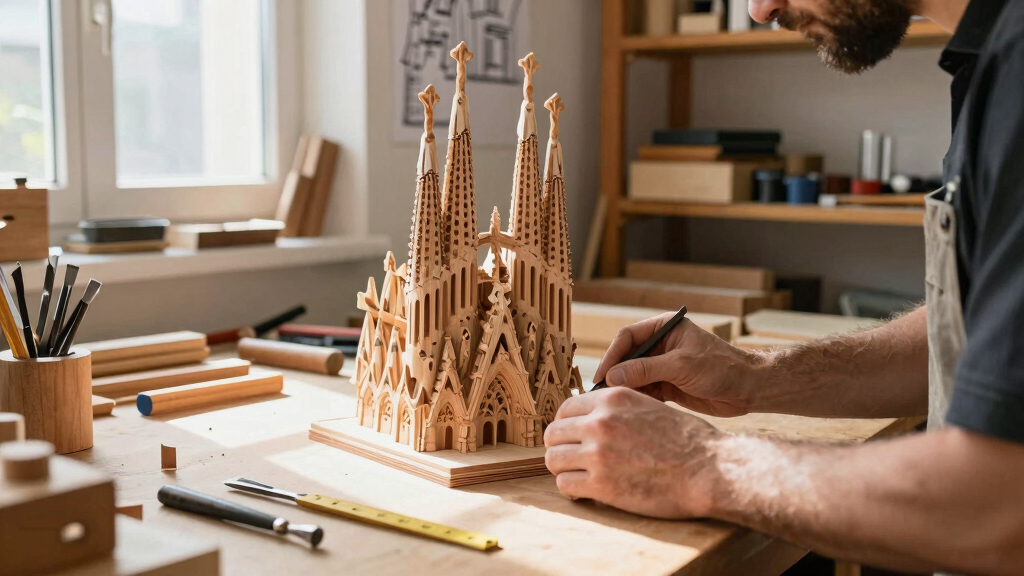
Researchers have uncovered new mathematical principles embedded in the design of Barcelona’s Sagrada Familia. The discovery sheds light on Antoni Gaudí’s use of complex geometry, confirming that his architecture incorporates advanced mathematical patterns. The findings could influence future architectural analysis and preservation efforts.
Researchers have confirmed that the design of Barcelona’s Sagrada Familia incorporates complex mathematical patterns, including advanced geometric principles that Gaudí meticulously embedded into the cathedral’s architecture. The discovery, announced by a team of mathematicians and architects, highlights the deep connection between art and mathematics in Gaudí’s work and offers new insights into his innovative approach.
The research, conducted by a collaboration between the University of Barcelona and the Gaudí Research Institute, analyzed detailed architectural plans and 3D scans of the Sagrada Familia. They identified specific geometric configurations, such as the use of fractal-like patterns and the application of the golden ratio, which Gaudí reportedly integrated into the cathedral’s design. These mathematical structures are believed to enhance both aesthetic harmony and structural stability.
According to lead researcher Dr. Maria López, ‘Our analysis confirms that Gaudí’s architecture was not only inspired by nature and religion but also deeply rooted in advanced mathematical concepts. This adds a new dimension to understanding his work and the engineering behind it.’
Mathematical Patterns Deepen Understanding of Gaudí’s Innovation
This discovery matters because it reveals that Gaudí’s architectural genius was intertwined with complex mathematics, challenging previous assumptions that his designs were primarily intuitive or artistic. Recognizing these hidden patterns can influence how scholars interpret Gaudí’s work and inform preservation strategies, ensuring the mathematical integrity of the structure is maintained. It also underscores the importance of interdisciplinary approaches in architectural history and engineering.
geometric design tools for architects
As an affiliate, we earn on qualifying purchases.
As an affiliate, we earn on qualifying purchases.
Historical and Architectural Insights Into Gaudí’s Methods
Antoni Gaudí began working on the Sagrada Familia in 1882, and it remains unfinished. Over the years, many have speculated about the mathematical precision behind his designs, with some suggesting he employed geometric principles like the catenary arch and hyperbolic paraboloids. However, concrete evidence of specific mathematical structures had been elusive until now. Recent technological advances in 3D modeling and analysis have enabled researchers to identify these hidden patterns with greater certainty.
“Our findings confirm that Gaudí’s design is embedded with complex geometric principles, revealing an innovative fusion of art and mathematics.”
— Dr. Maria López
Remaining Questions About the Mathematical Foundations
While the research confirms the presence of complex geometric patterns, it is still unclear how extensively Gaudí integrated these principles into the entire structure or whether he employed other advanced mathematical techniques. Additionally, the precise influence of these patterns on the cathedral’s structural integrity requires further study. The research team emphasizes that their findings are a significant step but not the final word on Gaudí’s mathematical methods.
Further Analysis and Preservation Strategies Underway
Researchers plan to continue analyzing the cathedral’s remaining sections and explore how these mathematical principles can inform restoration efforts. They also aim to develop detailed models that can assist in future construction and conservation, ensuring the mathematical and artistic integrity of Gaudí’s masterpiece is preserved for generations.
Key Questions
What specific mathematical principles did Gaudí use in Sagrada Familia?
Researchers have identified geometric patterns such as fractal-like structures, the golden ratio, and hyperbolic forms embedded in the design, reflecting Gaudí’s use of advanced geometry.
How does this discovery change our understanding of Gaudí’s architecture?
It reveals that Gaudí’s work was not only artistic but also deeply rooted in complex mathematical concepts, showcasing his innovative approach to design and engineering.
Will this impact future restoration or construction efforts at Sagrada Familia?
Yes, understanding these mathematical patterns can guide more accurate restoration and preservation strategies, maintaining the structural and aesthetic integrity of the cathedral.
Are there plans to apply these findings to other Gaudí projects?
Researchers are considering analyzing Gaudí’s other works, such as Park Güell and Casa Batlló, to see if similar mathematical principles are present.
Source: hn
Fall yard work Picks
leaf blowers
As an affiliate, we earn on qualifying purchases.