Choosing the right angle gauge for your table saw can significantly impact the precision and quality of your cuts. In 2026, the market offers a variety of options, from simple mechanical tools to advanced digital devices. The POWERTEC 71828 Digital Angle Finder stands out for high accuracy and ease of use, ideal for professionals who need precise measurements. The Stainless Steel Bevel Gauge 15-120 Degree offers durability and portability for quick checks on the go, perfect for hobbyists or contractors who value ruggedness. Meanwhile, the WoodRiver Bevel Angle Gauge provides laser-engraved markings for common sharpening angles, making it a smart choice for woodworkers focused on sharpening consistency. Each has tradeoffs: digital precision versus simplicity, durability versus delicate markings. Here’s what you need to know before choosing the best fit for your workshop.

Get business pricing on tools and workshop supplies
- Business-only prices and quantity discounts
- Tax-exempt purchasing
- Multiple users, one account, clear invoices
Complete the kit


Key Takeaways
- Digital gauges like POWERTEC 71828 deliver the highest precision for complex projects.
- Stainless steel gauges are durable and portable but lack digital readouts.
- Specialized gauges such as WoodRiver excel at marking common sharpening angles.
- Consider your typical workflow: frequent adjustments or occasional checks.
- Tradeoffs include digital complexity versus mechanical simplicity and portability.
| Stainless Steel Bevel Gauge 15-120 Degree |  | Best for Portability and Basic Angle Checks | Material: Stainless steel | Angle Range: 15-120 degrees | Attachment: Keychain hole | VIEW ON AMAZON | See Our Full Breakdown |
| POWERTEC 71828 Digital Angle Finder Gauge for Table Saws and Woodworking | 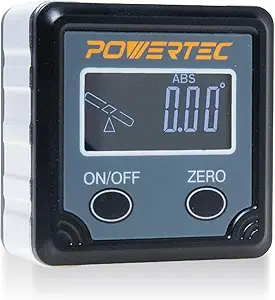 | Best for Precision and Digital Readouts | Brand: POWERTEC | Model: 71828 | Accuracy: ±0.2° (±0.1° at 0° and 90°) | VIEW ON AMAZON | See Our Full Breakdown |
| WoodRiver Bevel Angle Gauge |  | Best for Sharpening and Common Angles | Manufacturer: Woodcraft Supply | Part Number: JM23015A | Diameter: 2-3/4 inches | VIEW ON AMAZON | See Our Full Breakdown |
| angle gauges for table saw blade | Material |
|---|---|
| Stainless Steel Bevel Gauge 15 | Stainless steel |
| POWERTEC 71828 Digital Angle F | Aluminum |
| WoodRiver Bevel Angle Gauge | Stainless Steel |
More Details on Our Top Picks
Stainless Steel Bevel Gauge 15-120 Degree
This stainless steel bevel gauge is a straightforward tool designed for quick and easy angle measurements. Its broad 15 to 120-degree range covers most common woodworking and carpentry needs. Compared with digital options, it lacks precision readouts, but its durable construction and portability make it ideal for on-the-fly adjustments. The keychain hole adds to its convenience for mobile use. However, it’s limited to manual readings and doesn’t offer advanced features like digital calibration or memory. It’s best suited for hobbyists or contractors who prefer a rugged, no-fuss tool.
Pros:- Durable stainless steel construction
- Wide adjustable angle range
- Lightweight and portable with keychain attachment
Cons:- Limited to manual measurement
- No digital readout or advanced features
Best for: Hobbyists and carpenters needing a simple, portable angle checker
Not ideal for: Professionals requiring high-precision measurements or digital features
- Material:Stainless steel
- Angle Range:15-120 degrees
- Attachment:Keychain hole
Our verdict“A reliable, no-frills tool perfect for quick checks and portable use, though less suited for precision tasks.”
POWERTEC 71828 Digital Angle Finder Gauge for Table Saws and Woodworking
The POWERTEC 71828 stands out for its high accuracy, offering ±0.2° (and ±0.1° at 0° and 90°) precision, making it ideal for professional woodworking where exact angles matter. Its magnetic base ensures it stays securely on ferrous surfaces, and the compact aluminum body makes it portable. The device provides a digital readout with a resolution of 0.05°, simplifying complex measurements and adjustments. While it’s pre-calibrated and ready to use, the batteries are not included, which can be an inconvenience. Limited to a 4×90° measurement range, it’s best for precise tasks, but less suited for measuring broad angles or non-metallic surfaces.
Pros:- High accuracy of ±0.1° at 0° and 90°
- Strong magnetic base for versatile attachment
- Compact and lightweight design
- Pre-calibrated and ready to use
Cons:- Batteries not included
- Limited to 4×90° measuring range
Best for: Professional woodworkers and carpenters needing exact measurements
Not ideal for: DIYers with occasional use or those avoiding digital devices
- Brand:POWERTEC
- Model:71828
- Accuracy:±0.2° (±0.1° at 0° and 90°)
- Resolution:0.05°
- Measuring Range:4 x 90°
- Material:Aluminum
- Auto Shut-Off:5 minutes
Our verdict“A highly accurate digital tool suited for precision-focused tasks, albeit with a limited measurement range and battery dependency.”
WoodRiver Bevel Angle Gauge
The WoodRiver Bevel Angle Gauge offers a different approach, focusing on precision with laser-engraved markings for 10 common sharpening and grinding angles. Its stainless steel construction ensures durability, and the 2-3/4-inch diameter size makes it easy to handle and read. While it’s ideal for maintaining consistent sharpening angles, its thin profile (0.01 inches) may make it somewhat fragile if mishandled. This gauge is particularly suited for woodworkers who need to regularly set or verify sharpening angles rather than general cut angles on a table saw.
Pros:- Laser-engraved markings for 10 common angles
- Precision-cut stainless steel
- Compact size with protective sleeve
- Good for sharpening setups
Cons:- Thin profile may be delicate
- Limited to preset angles, not adjustable
Best for: Woodworkers focused on sharpening consistency and common angles
Not ideal for: Users needing adjustable or broad angle measurements
- Manufacturer:Woodcraft Supply
- Part Number:JM23015A
- Diameter:2-3/4 inches
- Measurement System:English
- Number of Angles:10
- Material:Stainless Steel
Our verdict“An excellent choice for sharpening and grind consistency, especially for those who frequently work on sharpening angles.”
How We Picked
Our selection process focused on tools designed specifically for measuring and setting angles on table saw blades. We prioritized accuracy, build quality, ease of use, and versatility. Digital models were evaluated for their precision and features like magnetic bases and auto shut-off, while mechanical gauges were assessed for durability and readability. We aimed to include options suitable for both professional workshops and hobbyist setups, balancing advanced features with straightforward functionality. Ultimately, our picks reflect a range of needs — from high-tech to highly durable and specialized tools.
| angle gauges for table saw blade | Material |
|---|---|
| Stainless Steel Bevel Gauge 15 | Stainless steel |
| POWERTEC 71828 Digital Angle F | Aluminum |
| WoodRiver Bevel Angle Gauge | Stainless Steel |
Factors to Consider When Choosing Angle Gauges For Table Saw Blades
Choosing the right angle gauge for your table saw depends on your specific needs, workflow, and budget. While digital gauges offer precision and ease of use, mechanical gauges excel in durability and portability. Specialized gauges are perfect for sharpening angles, which is a common task for woodworkers aiming for consistency. Consider how often you’ll need to measure angles, the level of accuracy you require, and whether you prefer digital or mechanical tools. This guide will walk you through the key features and tradeoffs to help you make an informed choice.
Digital vs. Mechanical Angle Gauges
Digital angle gauges like the POWERTEC 71828 provide high precision with easy-to-read displays, making them ideal for projects that demand exact measurements. They often include features like magnetic bases and auto shut-off, enhancing convenience. Mechanical gauges, such as the stainless steel bevels, excel in ruggedness and simplicity, making them suitable for quick checks or outdoor use where electronic components might be vulnerable. Your choice depends on whether you prioritize accuracy or durability and portability.
Specialized vs. General Purpose Gauges
For tasks like sharpening and grinding, gauges like the WoodRiver Bevel Angle Gauge with laser-engraved angles provide quick reference points for common angles, streamlining setup for repetitive tasks. General-purpose gauges, like the stainless steel bevel, are more flexible but require manual reading and adjustment. Decide if your focus is on precise angle setting on the saw or on maintaining consistent sharpening angles—your workshop’s core activities will guide this decision.
Durability and Portability
If you move between job sites or work outdoors, a durable, portable gauge like the stainless steel option might serve better. For in-shop setups with stable surfaces, digital gauges with magnetic bases and advanced features can save time and increase accuracy. Consider the environment and your workflow frequency when choosing, balancing ruggedness with technological features.
Frequently Asked Questions
How do I calibrate a digital angle gauge?
Most digital angle gauges come pre-calibrated, but it’s wise to verify calibration periodically, especially after drops or impacts. To calibrate, place the gauge on a flat, known surface like a precision level or a perfectly horizontal surface. Follow the manufacturer’s instructions, usually involving zeroing the device or setting it to known angles like 0° or 90°. Proper calibration ensures your measurements remain accurate over time.
Are stainless steel gauges suitable for outdoor use?
Yes, stainless steel gauges are generally well-suited for outdoor or workshop environments due to their durability and resistance to corrosion. They can withstand knocks and exposure to moisture better than plastic or fragile materials. However, for digital gauges, ensure that they are stored properly to prevent damage to sensitive electronic components, especially in harsh conditions.
Can I use a regular protractor as an angle gauge?
While a protractor can serve in a pinch, dedicated angle gauges provide more precision and ease of use for woodworking tasks. Protractors often lack the durability, fine resolution, or features like magnetic bases that make dedicated gauges more practical. For critical cuts and setup, investing in a purpose-built tool is usually worth the extra cost and effort.
What is the most accurate type of angle gauge for table saws?
Digital angle gauges like the POWERTEC 71828 typically offer the highest accuracy, with precision down to ±0.1° or better. Their digital readouts eliminate parallax errors common with mechanical tools. However, for absolute precision, calibration and proper use are essential. Mechanical gauges can also be very accurate if carefully calibrated and used correctly, but digital devices tend to be more consistent and user-friendly.
How often should I check or calibrate my angle gauge?
Frequency depends on how often you use the gauge and the conditions it endures. For professional use, calibrate at least quarterly or after any impact. Hobbyists may find annual calibration sufficient, but it’s always good practice to verify accuracy before critical projects. Regular checks help maintain measurement integrity and ensure your cuts stay precise over time.
Conclusion
For professional woodworkers and carpenters who demand the highest accuracy, the POWERTEC 71828 Digital Angle Finder makes the most sense. Hobbyists or contractors focused on portability and ruggedness will appreciate the simplicity and durability of the Stainless Steel Bevel Gauge. Those specializing in sharpening or requiring preset angles will benefit from the WoodRiver Bevel Angle Gauge. Your choice hinges on balancing precision, durability, ease of use, and the specific tasks you prioritize in your workshop.
Fall yard work Picks
leaf blowers
As an affiliate, we earn on qualifying purchases.