
Mastering classic joints elevates woodworking from simple construction to an art form. You combine precision craftsmanship with timeless design, focusing on perfecting techniques like dovetails and mortise and tenon. Attention to detail guarantees your joints are both strong and visually appealing, reflecting your skill and dedication. As you refine your skills, you’ll see how craftsmanship transforms basic materials into enduring works of art. Keep exploring, and you’ll discover how mastering these techniques truly elevates your work.
Key Takeaways
- Mastering classic joints showcases craftsmanship and elevates woodworking to an art form.
- Precision in measuring and cutting ensures seamless, aesthetically pleasing, and durable joints.
- Proper technique and patience are essential for executing traditional joinery with excellence.
- Selecting suitable materials enhances the strength and beauty of well-crafted joints.
- Perfecting joinery reflects technical skill, artistic sensibility, and a dedication to quality craftsmanship.
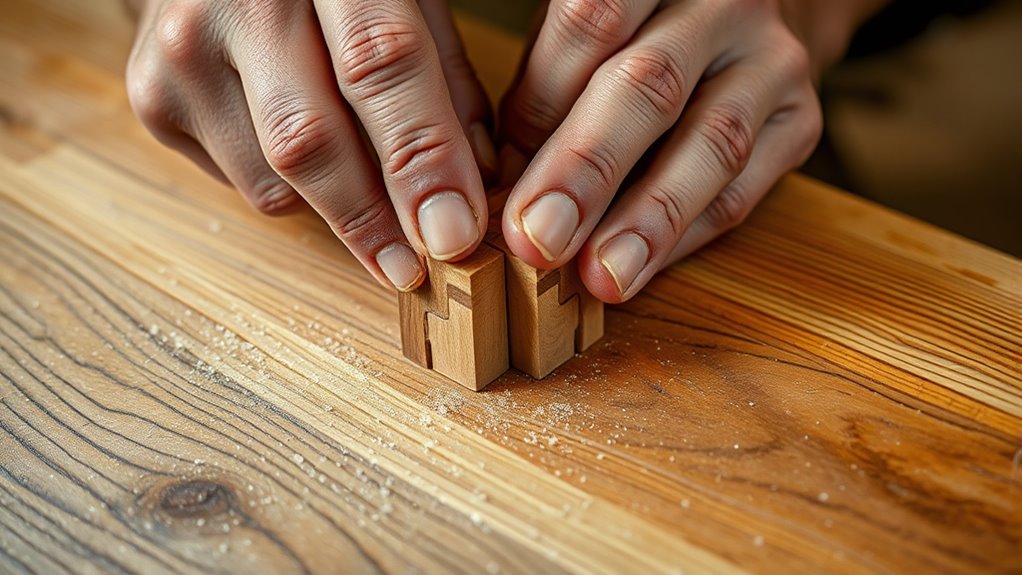
Joinery transforms functional woodworking into a timeless art form, where craftsmanship and creativity combine to produce pieces that are both beautiful and durable. When you focus on perfecting classic joints, you’re engaging in a discipline that demands woodworking precision and mastery of craftsmanship techniques. These skills are essential for creating joints that not only hold strong but also enhance the aesthetic appeal of your work. Every cut, fit, and assembly requires careful attention to detail—there’s no room for guesswork in traditional joinery. Precision ensures that each joint aligns perfectly, resulting in a seamless look and structural integrity that endures over time.
Mastering craftsmanship techniques involves understanding the nuances of different joinery methods, such as mortise and tenon, dovetail, dado, and finger joints. Each of these has its unique requirements and historical significance, and as you learn them, you develop a deeper appreciation for the artistry behind woodworking. Precision becomes even more critical here, as small errors can compromise the strength or appearance of your finished piece. To achieve this, you need to develop a steady hand, sharp tools, and a keen eye for measurement and fit. Using high-quality tools and proper techniques reduces the margin of error and elevates your craftsmanship.
In traditional joinery, every joint is a tribute to your skill. You carefully select the right wood, considering grain direction and density, to ensure the joint’s longevity. You might use a chisel, saw, or router, but what matters most is your ability to execute each cut with accuracy. This requires patience and practice, as well as an understanding of how different woods respond to cutting and fitting. When you assemble the joint, your goal is a tight, flush fit, demonstrating your woodworking precision. The result isn’t just a sturdy connection but a visually appealing detail that showcases your craftsmanship techniques.
As you refine your skills, you realize that perfect joinery elevates your work from mere construction to art. Each joint becomes a signature of your craftsmanship, reflecting both technical skill and aesthetic sensibility. It’s about more than just structural integrity; it’s about creating pieces that stand the test of time and tell a story of dedication and mastery. Developing accurate measurement skills is crucial for ensuring that each joint fits perfectly, which significantly impacts the overall quality of your work. By continually practicing these techniques and honing your woodworking precision, you embed a sense of craftsmanship into every project, transforming simple wood into a work of art.
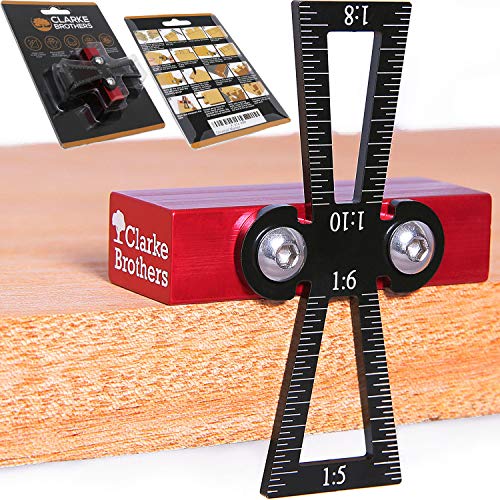
Dovetail Marker – Wood Dovetail Tool – Woodworking Hand Tool for Crafts – Precise Dovetail Guide with 1:5, 1:6, 1:8 and 1:10 Slopes – Extra-Large Body – Ergonomic Design
PATENT PENDING – PRECISE TOOL: Cutting dovetail joints is easier than ever before with our dovetail marker! This…
As an affiliate, we earn on qualifying purchases.
As an affiliate, we earn on qualifying purchases.
Frequently Asked Questions
What Are the Origins of Traditional Joinery Techniques?
You might find that traditional joinery techniques originate from centuries of historical craftsmanship, where artisans refined skills through practical experience. Cultural influences shaped these methods, with different regions developing unique joints suited to their materials and aesthetic values. By studying these origins, you understand how ancient builders created durable, functional connections, passing down these techniques as a proof to their craftsmanship and cultural heritage.
How Do Modern Tools Influence Joinery Craftsmanship?
Modern tools, like power tools, substantially influence your joinery craftsmanship by making precise cuts and intricate joints faster and more consistent. Digital precision allows you to achieve flawless results, reducing errors and saving time. As a result, you can focus on the artistry of your work, blending traditional techniques with innovative technology to elevate your craftsmanship and create beautifully crafted, durable joints that stand the test of time.
Can Joinery Be Customized for Unconventional Furniture Designs?
Yes, you can customize joinery for unconventional furniture designs using innovative techniques. By incorporating custom design elements, you can create unique joints that fit your creative vision. Modern tools make it easier to experiment with complex and innovative joinery methods, allowing you to push boundaries and craft one-of-a-kind pieces. This approach lets you blend traditional craftsmanship with contemporary ideas, resulting in functional art that stands out.
What Are Common Mistakes to Avoid in Joinery Work?
To avoid common joinery mistakes, make sure you prevent joint misalignment by carefully measuring and marking your cuts. Don’t rush the process—improper adhesive use can weaken your joints, so apply it evenly and appropriately. Keep your tools sharp and work patiently. Also, double-check your work before final assembly to guarantee precision. Paying attention to these details helps you create strong, flawless joints that last.
How Does Joinery Contribute to Furniture Longevity and Stability?
You enhance furniture longevity and stability through expert joinery, ensuring joinery durability and structural integrity. By skillfully fitting joints like dovetails or mortise and tenon, you create strong connections that resist wear and tear over time. Precise craftsmanship minimizes weak spots, preventing wobbling or breakage. As a result, your furniture remains durable, stable, and able to withstand daily use, showcasing the true strength of well-executed joinery.

YUEWO Mortising Attachment for Drill Press, Bench Drill Locator Set for Mortising Chisels Drilling Machine, Square Hole Hollow Chisel Mortiser Drill Bit for Woodworking, Mortise and Tenon Joint Tools
Dimension – This mortising attachment fits bench drill quill diameters of 2.09", 2.17", 2.28", 2.36", 2.56". Complete with…
As an affiliate, we earn on qualifying purchases.
As an affiliate, we earn on qualifying purchases.
Conclusion
You can see joinery as an art form by mastering classic joints. You can appreciate the craftsmanship behind each connection, the skill required to perfect every detail, and the beauty that comes from precision and patience. You can elevate your woodworking, impress with your craftsmanship, and create pieces that stand the test of time. Joinery is not just a skill; it’s a craft, a passion, and a timeless tradition waiting for you to explore.

Lanties 6 Pcs Woodworking Tools Set, Includes 4 Wood Chisels (1/4", 1/2", 3/4", 1"), 6-Inch Double-Edge Blade & Coping Saw, Hand Tool Starter Kit for DIY Dovetail, Joinery & Wood Carving
Woodworking Starter Kit:Perfect solution for DIYers and beginners.This 6-piece bundle includes 4 bevel edge chisels, 1 flexible double-edge…
As an affiliate, we earn on qualifying purchases.
As an affiliate, we earn on qualifying purchases.

Saysurey 4 Pcs Woodworking Ruler, Metal Precision Pocket Rulers 12, 8, 6 Inch with 3D Multi Angle Measuring Ruler 45/90 Degree for Precision Measuring Marking Inch and Metric
Your Woodworking Essential: a package that includes 3 pieces of woodworking ruler (in 3 sizes, 6 inches, 8…
As an affiliate, we earn on qualifying purchases.
As an affiliate, we earn on qualifying purchases.