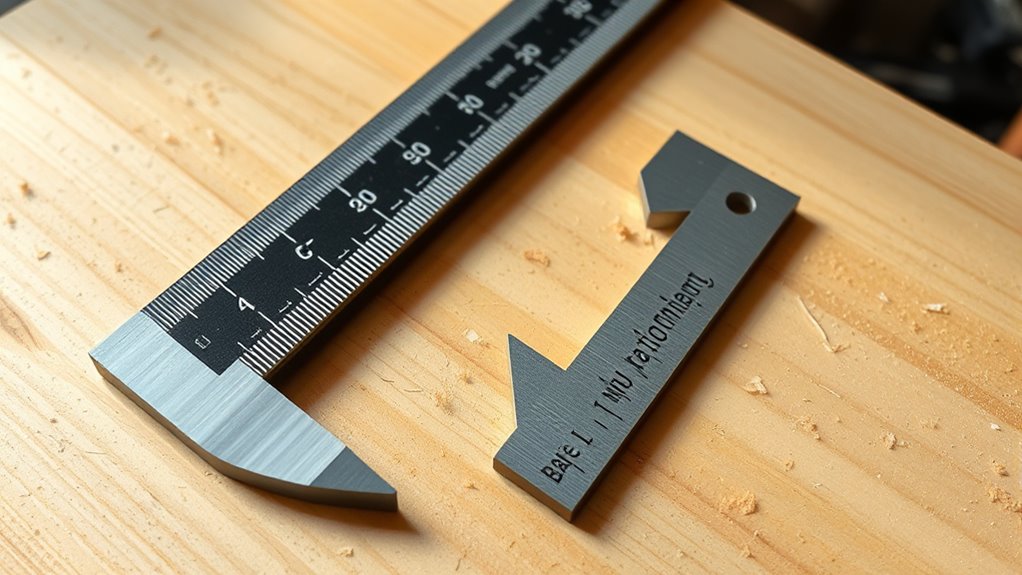

To layout compound miters with gauge and bevel methods, first measure the exact angle between your pieces using a protractor or angle gauge. Set your miter saw to this angle, then tilt the blade to the calculated bevel angle, which you determine through geometry or specific formulas. Double-check your settings before cutting to guarantee precision. If you keep these steps in mind, you’ll create tight, professional joints—more tips await if you continue exploring.
Key Takeaways
- Measure the joint angle accurately with a protractor or angle gauge to determine the miter cut setting.
- Calculate the bevel angle based on the joint angle and wood thickness to set the saw tilt correctly.
- Set the miter gauge on the saw to the measured joint angle for precise lateral cutting.
- Adjust the saw blade to the calculated bevel angle to tilt the blade appropriately for compound cuts.
- Verify settings with test cuts on scrap material, ensuring both gauge and bevel adjustments produce a perfect fit.
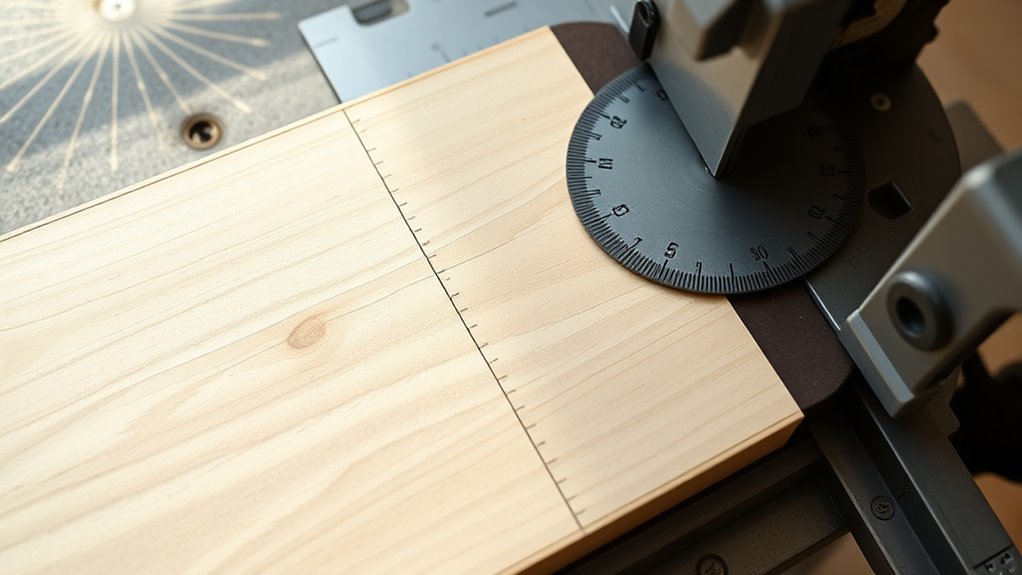
Creating accurate compound miter cuts is essential for achieving tight, professional-looking corner joints in woodworking projects. These cuts involve both an angle measurement and a bevel calculation, making them more complex than standard miter cuts. To master this process, you need to understand how to properly gauge the angles and set your saw accordingly. The key lies in translating the angles into precise measurements that your saw can interpret, ensuring each piece fits perfectly when assembled.
Mastering compound miter cuts ensures tight, professional corner joints in woodworking projects.
When preparing for a compound miter cut, start by determining the angle measurement that will produce the desired joint. This often involves using a protractor or angle gauge to find the exact angle between the two surfaces you need to join. Once you have this angle, you’ll need to perform a bevel calculation to determine the tilt of your saw blade relative to the vertical. The bevel calculation accounts for the compound nature of the cut, which combines the miter angle with the tilt of the blade. It’s important to understand that the bevel angle isn’t just a simple measurement; it’s a calculated value based on the angle measurement and the geometry of the joint.
To accurately set your saw, you need to convert these measurements into the saw’s settings. Many modern miter saws have an adjustable bevel and miter gauge, allowing you to input the specific angles needed. You’ll set the miter angle to match the angle measurement and then tilt the blade to the calculated bevel angle. Doing this precisely ensures that when the cut is made, the two pieces will come together seamlessly at the corners, with minimal gaps or misalignment.
The process of gauge and bevel setting can seem intimidating at first, but with practice, it becomes second nature. Always double-check your measurements before making a cut, and consider making test cuts on scrap material to verify your settings. Remember, small inaccuracies in angle measurement or bevel calculation can lead to poorly fitting joints, so patience and precision are key. Use your square or digital angle finder to confirm your settings, and take your time to set the saw accurately. Additionally, understanding the importance of proper measurement can significantly improve your results. With careful measurement and calculation, you’ll produce compound miter cuts that fit perfectly, giving your projects a polished, professional appearance.

Klein Tools 935DAG Digital Electronic Level and Angle Gauge, Measures 0 – 90 and 0 – 180 Degree Ranges, Measures and Sets Angles
- Versatile Digital Angle Gauge: Measures and sets angles from 0-180°
- Zero Calibration Feature: Check relative angles easily
- Digital Level Function: Use as a digital level
As an affiliate, we earn on qualifying purchases.
As an affiliate, we earn on qualifying purchases.
Frequently Asked Questions
What Tools Are Best for Measuring Compound Angles Accurately?
To measure compound angles accurately, you should use digital protractors and bevel gauges. Digital protractors provide precise readings with easy-to-read displays, making them ideal for complex angles. Bevel gauges help you transfer and verify angles on your workpiece. Together, these tools guarantee you get accurate measurements, reducing errors in your compound miter cuts. Always double-check your readings for best results and smooth, professional joints.
How Do Temperature Changes Affect Compound Miter Cuts?
Temperature changes cause thermal expansion, which can affect your compound miter cuts by slightly altering the material’s dimensions. When the temperature rises, materials expand, making your cuts less precise if you don’t account for this. To maintain accuracy, consider material stability and perform cuts in a consistent, controlled temperature environment. This helps ensure your miter joints fit perfectly, regardless of external temperature fluctuations.
Can Software Assist in Planning Compound Miter Layouts?
It turns out software can be a real game-changer for planning compound miter layouts. You can use digital templates and angle calculators to precisely determine your cuts, reducing errors and saving time. Many programs allow you to visualize complex angles, making it easier to anticipate how pieces will fit together. This coincidence of technology and craftsmanship helps you achieve perfect joints, even with intricate compound angles, effortlessly elevating your woodworking projects.
What Are Common Mistakes to Avoid During Compound Miter Cutting?
You should avoid common mistakes like misaligned blades, which can cause uneven cuts, and improper clampings, leading to unstable workpieces. Always double-check your blade angles and verify they’re securely locked before cutting. Keep your workpiece firmly clamped, so it doesn’t shift during the cut. Taking these precautions helps achieve precise compound miters and prevents errors that could ruin your project or cause injury.
How Do I Adjust for Imperfections in My Saw Blades?
Did you know that improperly calibrated saw blades can cause up to a 15% increase in cut errors? To fix imperfections, start with saw blade calibration—ensure your blade is aligned correctly. Next, perform blade tension adjustment if your saw has that feature. Regularly checking and maintaining these settings keeps your cuts precise, especially for compound miters, and prevents costly mistakes or uneven joints.
Conclusion
Think of mastering compound miters like tuning a fine instrument—you need just the right gauge and bevel settings to hit the perfect note. When you understand these methods, your cuts come together smoothly, like a well-orchestrated symphony. With practice, you’ll craft joints that fit perfectly every time, transforming your woodworking projects from good to truly impressive. Keep honing your skills, and soon you’ll be conducting your own masterpiece with confidence and precision.